GCSE Spanish mockPearson Edexcel Foundation · Edexcel 1SP1
Writing mock paper: Pearson Edexcel Foundation
Paper 3 of 4 of the Pearson Edexcel Foundation mock, at full length and with the official time. New questions you won't have seen on our practice pages. Your answers are saved on this device as you go.
Pearson Edexcel Foundation writing paper
1 hour 15 minutes, 50 marks: 4 questions. Answer all questions; where there are two, choose one.
Write your answers in Spanish. You must not use a dictionary. You aren't penalised for writing more or fewer words than recommended, and everything you write is marked.
Timed mode gives you the official 1 hour 15 minutes for the paper. Press start when you're ready.
Question 1
Four sentences about a photo
(8 marks)
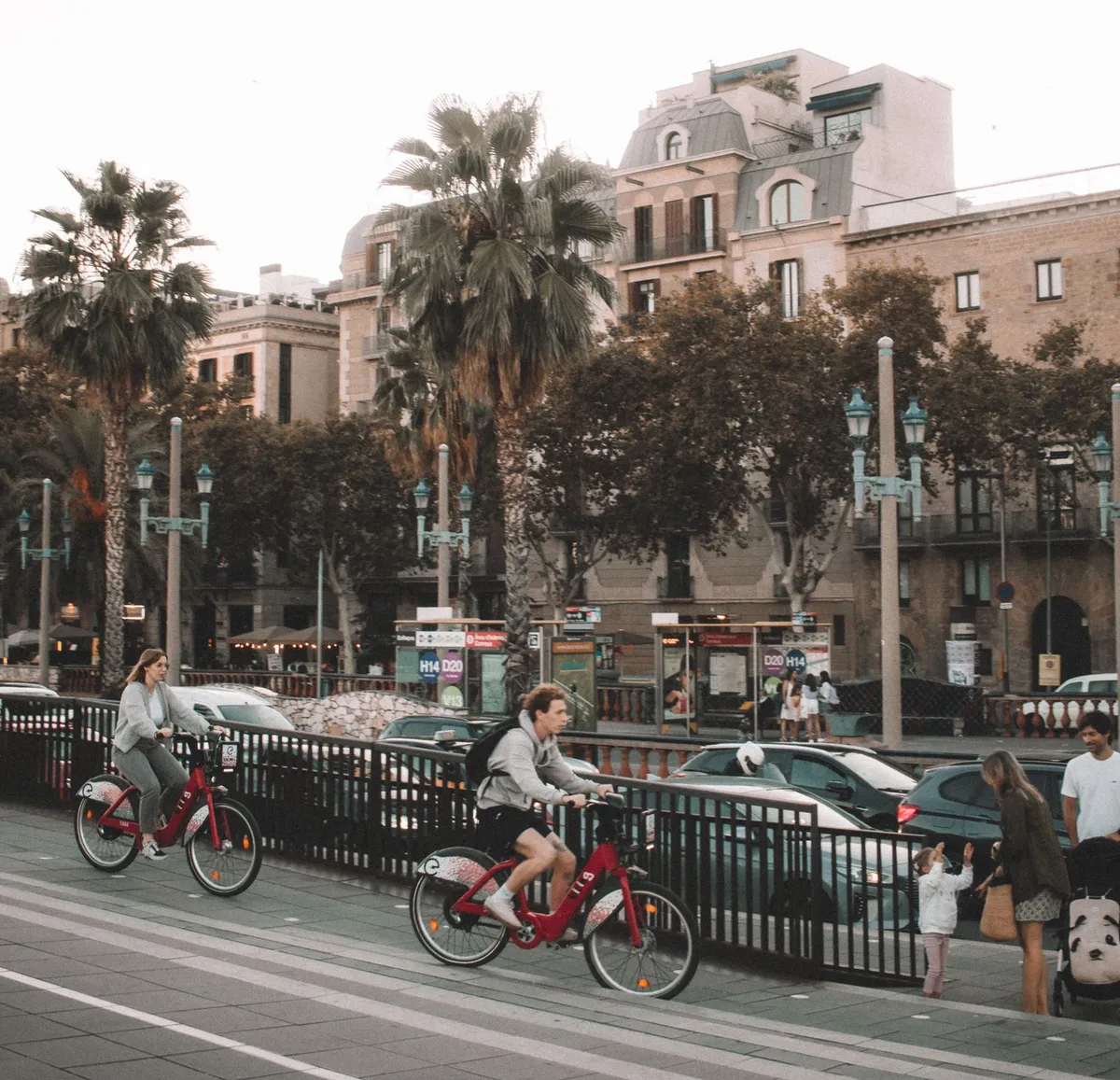
Describe the photo. Write four short sentences in Spanish.
A city street (Barcelona). A young woman and a young man ride red bicycles on a cycle path. Behind them there are palm trees, old buildings and cars on the road. On the right, a woman stands with a small child and a pushchair, next to a man.
Your answer
The model answer
Dos jóvenes (present) montan en bicicleta.
Las bicicletas (present) son rojas.
(present) Es una calle de una ciudad grande.
A la derecha (present) hay una madre con un niño pequeño.
Why it works
Four complete sentences, each with a verb: the 2 marks per sentence need relevant information in a sentence with a verb.
Montar en bicicleta (to ride a bike) and a la derecha (on the right) are worth learning for photo questions.
Rojas agrees with las bicicletas: a slip here would be minor, but a missing verb would cost a mark.
Question 2
A formal task of 40-50 words
(14 marks)
Question 2.1
Write an article for your school website about a sports club. Write your answer in Spanish. You should aim to write between 40 and 50 words.
0 words (aim for 40-50)
Your answer
The model answer (45 words)
Present
Future
Opinion and reason
Connective
En mi instituto (present) hay un club de baloncesto.
(present) Jugamos los lunes y los jueves después de clase.
(opinion and reason) Creo que las actividades son muy divertidas (connective) porque el profesor es simpático.
El año que viene el club (future) va a participar en una competición en Londres.
¡(future) Será fantástico!
Why it works
The three things this question assesses are all here: facts (when the club meets), an opinion with a reason, and the present and future timeframes.
Va a participar and será are two different ways of referring to the future.
Porque links the opinion to its reason: the language marks reward sentences linked with conjunctions.
Question 2.2
Write an article for a Spanish website about healthy eating. Write your answer in Spanish. You should aim to write between 40 and 50 words.
0 words (aim for 40-50)
Your answer
The model answer (44 words)
Present
Future
Opinion and reason
Connective
Normalmente (present) desayuno cereales y para comer (present) tomo un bocadillo en el instituto.
Por la noche (present) cenamos pescado o pollo con verduras.
(opinion and reason) En mi opinión, la comida rápida es mala (connective) porque no es nada sana.
En el futuro (future) comeré más fruta y (future) beberé más agua.
Why it works
Each bullet point is covered in order: a normal day (present), an opinion with a reason, then the future (comeré, beberé).
Time phrases (normalmente, por la noche, en el futuro) make the timeframes clear to the reader.
A negative (no es nada sana) adds variety without risk.
Question 3
An informal task of 80-90 words
(18 marks)
Question 3.1
Write a letter to your Spanish friend about birthdays. Write your answer in Spanish. You should aim to write between 80 and 90 words.
0 words (aim for 80-90)
Your answer
The model answer (82 words)
Past
Present
Future
Opinion and reason
Connective
Complex structure
¡Hola, Sofía!
Normalmente (present) celebro mi cumpleaños en casa con mi familia.
Mi madre (present) prepara una cena especial y mis abuelos (present) vienen a comer tarta.
(opinion and reason) Me encantan los regalos (connective) porque son una sorpresa, (connective) aunque (opinion and reason) prefiero las experiencias.
El año pasado (past) fui a un parque de atracciones con tres amigos.
(past) Subimos a todas las atracciones y después (past) comimos pizza.
(opinion and reason) ¡Lo (past) pasé genial! Este año (future) voy a cumplir dieciséis años y (future) haré una fiesta en la playa (complex structure) si hace buen tiempo.
¿(future) Vendrás?
Un abrazo, Sam
Why it works
Four bullet points, answered in order: present, opinion with reasons, past, future.
Three timeframes, which the top language mark needs: celebro, prepara (present); fui, subimos, comimos (past); voy a cumplir, haré, vendrás (future).
Development on every bullet point: who with, where and what happened, as the communication marks reward. A si clause adds complex language.
Question 3.2
Write an email to your Spanish friend about where you live. Write your answer in Spanish. You should aim to write between 80 and 90 words.
0 words (aim for 80-90)
Your answer
The model answer (82 words)
Past
Present
Future
Opinion and reason
Connective
Complex structure
¡Hola, Diego!
(present) Vivo en un piso pequeño en el centro de Bristol con mi madre y mi hermano.
(present) Tenemos tres dormitorios y un balcón con plantas.
(opinion and reason) Me gusta mucho mi barrio (connective) porque hay muchas tiendas y cafeterías, (connective) pero (opinion and reason) a veces hay demasiado ruido.
El año pasado (past) abrieron una biblioteca nueva al lado de mi casa y ahora (present) estudio allí los fines de semana.
En el futuro (future) voy a vivir en el campo (complex structure) para tener un jardín grande.
¿Y tú?
Un abrazo, Alex
Why it works
Every bullet point is covered: the flat (present), an opinion with a reason and a drawback, a change (abrieron, past) and the future (voy a vivir).
Abrieron (they opened) is a neat way to describe a change without needing a passive.
Para + infinitive (para tener) and the pero clause make extended sentences, which the language marks reward.
Question 4
Translation into Spanish
(10 marks)
Translate the following sentences into Spanish. (41 words)
I live in a big city.
There is a park near my house.
My brother and I play football every Saturday.
Yesterday we went to the market with my mother.
Next summer I am going to visit my cousins in Spain.
One model translation
Vivo en una ciudad grande.
Hay un parque cerca de mi casa.
Mi hermano y yo jugamos al fútbol todos los sábados.
Ayer fuimos al mercado con mi madre.
El verano que viene voy a visitar a mis primos en España.
Models written for this site to show what the mark schemes describe. Examiners mark the whole answer, so no single feature guarantees a mark. Minor errors make the message slower to understand but don't stop it: slight spelling slips, gender, missing accents, contractions (de el), word order, adjective agreement, prepositions. Major errors stop the message: wrong verb formation (podo, sabo), the wrong tense ("El sábado pasado iré"), an infinitive instead of a conjugated verb, misleading spellings.
We use cookies for anonymous statistics that show us which lessons help most, so we can improve them. No ads, and we never sell your data.Cookies give us anonymous statistics to improve the lessons. No ads, never sold.Privacy