How the speaking exam works
On both boards the speaking test is 25% of your GCSE, worth 50 marks, and lasts 7 to 9 minutes at Foundation or 10 to 12 minutes at Higher, after 15 minutes' preparation. Your teacher conducts and records it; the board marks it. There are three tasks, in a different order on each board. Neither board has a separate general conversation now: the conversation is the second half of the last task.
AQA (8692)
Paper 2 (Speaking), 25% of the GCSE. Conducted and recorded by your teacher, marked by AQA.
Preparation
- 15 minutes' supervised preparation immediately before the test, for all three cards: the role-play, the reading aloud task and the photo card
- You can make as many notes as you like and use them at any point in the test; you hand them in at the end
- No dictionary, and you may not read the text out loud during the preparation time
- Marking stops at the maximum time: 9 minutes at Foundation, 12 at Higher
The three tasks, in order
| Task | Marks | Foundation | Higher |
|---|---|---|---|
| 1. Role-play | 10 | 1 to 1.5 minutes | 1 to 1.5 minutes |
| 2. Reading aloud | 15 | 2 to 2.5 minutes in total | 3 to 3.5 minutes in total |
| 3. Photo card | 25 | 4 to 5 minutes: about 1 minute on the photos, 3 to 4 minutes of conversation | 6 to 7 minutes: about 1.5 minutes on the photos, 4.5 to 5.5 minutes of conversation |
1. Role-play: what happens
5 tasks, 2 marks each: 2 if the message is conveyed without ambiguity, 1 if it is partly conveyed or ambiguous.
- The card sets the scene in English (in the sample cards you are talking to a Spanish-speaking friend, as tú) and gives five tasks in English
- Your teacher plays the other person, reads a set Spanish introduction and speaks first, then reads each line exactly as printed
- One task, marked ?, asks you to ask a question
- Include a verb in every answer: without an accurate verb a task gets at most 1 mark
Foundation All five tasks are in the present tense, and each asks for one detail.
Higher Four tasks are in the present tense and one refers to another timeframe (past or future). Some tasks ask for two details, or an opinion and a reason.
2. Reading aloud: what happens
5 marks for pronunciation of the text, 10 for your answers to the four questions (marked as a whole).
- Your teacher says "Lee el texto." You read a short text printed in separate sentences; the words assessed focus on the sound-symbol correspondences
- Then your teacher asks four questions on the topic of the text, exactly as written in the Teacher's Booklet. They are unprepared, all in the present tense, and don't test whether you understood the text
- Answer as fully as you can: the top band needs every question answered clearly, with at least two extended answers (three or more clauses) and another developed well (two clauses)
Foundation The text has at least 35 words.
Higher The text has at least 50 words and can include past and future forms.
3. Photo card: what happens
5 marks for talking about the photos, then 15 (communication) + 5 (range and accuracy of language) for the conversation.
- The card has two photos (black and white in the sample materials) from one of the three themes; the same photos are used at both tiers
- Your teacher says "Háblame de las fotos." Say at least one thing about each photo: talking about only one costs a mark. Any relevant content counts, even outside the theme
- Then comes an unprepared conversation on any of the three topics of the card's theme. Your teacher chooses the questions as it goes and asks follow-ups such as ¿Por qué?
- The reading aloud card and the photo card are always from different themes
Foundation About 1 minute on the photos, then 3 to 4 minutes of conversation.
Higher About 1.5 minutes on the photos, then 4.5 to 5.5 minutes of conversation.
Pearson Edexcel (1SP1)
Paper 1 (Speaking), 25% of the GCSE. Conducted and recorded by your teacher, marked by Pearson.
Preparation
- 15 minutes' supervised preparation immediately before the test: 14 minutes in the preparation room, then 1 minute in the exam room when you may practise the read aloud text out loud (it is recorded but not marked)
- Notes on one sheet of A4, and you may annotate the read aloud text; you can't write on the role play or picture cards
- Two weeks before the test you choose the thematic context for the picture task, from two offered at random
- No dictionary or other resources
The three tasks, in order
| Task | Marks | Foundation | Higher |
|---|---|---|---|
| 1. Read aloud | 12 | 1.5 to 2 minutes in total | 2 to 2.5 minutes in total |
| 2. Role-play | 10 | 1 to 1.5 minutes | 1 to 1.5 minutes |
| 3. Picture task | 28 | 4.5 to 5.5 minutes: description and questions 1.5 to 2, conversation 3 to 3.5 | 7 to 8 minutes: description and questions 2 to 2.5, conversation 5 to 5.5 |
1. Read aloud: what happens
8 marks for pronunciation (clarity and sound-symbol correspondences), 4 for the two answers (2 each).
- The card gives a scenario in English (for example, a friend has written to you), then the text to read
- You hand the card back, then your teacher asks two unprepared questions in the present tense about your likes, dislikes and opinions on the subject of the text
- Questions are asked as printed and may be repeated up to twice, never rephrased. A one-word answer gets at most 1 mark
- You are not marked on your accent: an English accent is fine as long as the sounds are clear and right
Foundation 35 to 40 words in 5 sentences.
Higher 50 to 55 words in 4 sentences.
2. Role-play: what happens
5 prompts, 2 marks each: 2 fully communicated, 1 partly or ambiguous; a one-word answer gets at most 1.
- Always a transactional setting: café or restaurant, shop or market, hotel, train station, tourist information office, cinema, theatre or concert hall, campsite, leisure centre, doctor's or hospital, or in town
- The setting is formal, but you don't have to use usted. Your teacher introduces the scene in English, plays the employee and speaks first
- Five prompts in English. The lines are read exactly as printed and may be repeated up to twice
Foundation Ask one question. Present tense (or a familiar conditional such as me gustaría).
Higher Ask two questions. Present tense (or me gustaría), and one question to answer in a future timeframe.
3. Picture task: what happens
8 for the description (4 response, 4 language), 4 for the two questions (2 each), 16 for the conversation (12 communication, 4 language).
- The card has two colour pictures on your chosen thematic context. Your teacher asks which one you have chosen, then asks you to describe it
- Your description must cover the people, the location and the activity. Your teacher may prompt with ¿Y la gente?, ¿Y dónde están?, ¿Y qué están haciendo? or ¿Algo más?
- Then two compulsory questions about your own experiences, likes and opinions, linked to the picture
- Then a conversation that starts with a set subject from the thematic context and moves on with questions in the present, past and future
Foundation Both compulsory questions are in the present tense.
Higher The first compulsory question is in the present tense and the second in the past.
Practise: board, tier and mode
Choose your board and tier (the other GCSE exam-practice pages remember the same choice). The tasks below follow your board's exam order. Learn mode shows the examiner's Spanish, hints, translations and model answers as you go. Exam mode shows only your card, offers the 15 minutes' preparation and keeps the model answers until the end.
Role-play
AQA: task 1 of 3. 10 marks, 1 to 1.5 minutes. The card is in English; your teacher plays your Spanish-speaking friend and speaks first. One task (?) asks you to ask a question, and every answer needs a verb.
Pearson Edexcel: task 2 of 3. 10 marks, 1 to 1.5 minutes. A formal, transactional setting: your teacher introduces it in English, plays the employee and speaks first. Ask one question at Foundation and two at Higher, where one prompt is about the future.
AQA Foundation role-play 1: Healthy living and lifestyle (People and lifestyle)
Instructions to candidates
- You are talking to your Spanish friend about healthy living.
- Your teacher will play the part of your friend and will speak first.
- You should address your friend as tú.
- When you see this, ?, you will have to ask a question.
In order to score full marks, you must include a verb in your response to each task.
- Say what you eat for breakfast. (Give one detail.)
- Say what sport you do. (Give one detail.)
- Give your opinion of fast food. (Give one opinion.)
- Say how many hours you sleep. (Give one detail.)
- Ask your friend a question about sport. (you ask a question)
Preparation: in the exam you get 15 minutes to prepare all three cards (role-play, reading aloud and photo card). Make notes on what you'll say for each task.
Press start. Your teacher speaks first; answer each line out loud, then press Next.
- Intro
Teacher: Estás hablando con tu amigo español. Yo soy tu amigo.
English
You are talking to your Spanish friend. I am your friend.
- Task 1
Say what you eat for breakfast. (Give one detail.)
Teacher: ¿Qué desayunas normalmente?
English
What do you usually have for breakfast?
Hint
Use desayuno (I have for breakfast) + a food: cereales, tostadas, fruta.
Model answer
Normalmente desayuno cereales con leche.
I usually have cereal with milk for breakfast.
- Task 2
Say what sport you do. (Give one detail.)
Teacher: ¿Qué deporte haces?
English
What sport do you do?
Hint
Juego al + sport (fútbol, tenis), or Hago + sport (natación, atletismo).
Model answer
Juego al baloncesto con mi equipo.
I play basketball with my team.
- Task 3
Give your opinion of fast food. (Give one opinion.)
Teacher: ¿Qué piensas de la comida rápida?
English
What do you think of fast food?
Hint
Creo que es... / Me gusta porque... A verb is needed for full marks.
Model answer
opinion: Creo que la comida rápida es mala para la salud.
I think fast food is bad for your health.
- Task 4
Say how many hours you sleep. (Give one detail.)
Teacher: ¿Cuántas horas duermes?
English
How many hours do you sleep?
Hint
Duermo (I sleep) + a number + horas.
Model answer
Duermo ocho horas cada noche.
I sleep eight hours every night.
- ? Ask
Ask your friend a question about sport.
Teacher: Vale.
English
OK.
Hint
Start with a question word: ¿Cuál es...?, ¿Qué...?, ¿Te gusta...?
Model answer
¿Cuál es tu deporte favorito?
What is your favourite sport?
Teacher: Me encanta el fútbol. Juego todos los sábados.
English
I love football. I play every Saturday.
End of the role-play. Compare your answers with the models above: each one conveys the whole message with a verb.
AQA Foundation role-play 2: Customs, festivals and celebrations (Popular culture)
Instructions to candidates
- You are talking to your Spanish friend about celebrations.
- Your teacher will play the part of your friend and will speak first.
- You should address your friend as tú.
- When you see this, ?, you will have to ask a question.
In order to score full marks, you must include a verb in your response to each task.
- Say when your birthday is. (Give one detail.)
- Ask your friend a question about festivals in Spain. (you ask a question)
- Say what you eat at a party. (Give one detail.)
- Say who you celebrate your birthday with. (Give one detail.)
- Say what you think of fireworks. (Give one opinion.)
Preparation: in the exam you get 15 minutes to prepare all three cards (role-play, reading aloud and photo card). Make notes on what you'll say for each task.
Press start. Your teacher speaks first; answer each line out loud, then press Next.
- Intro
Teacher: Estás hablando con tu amigo español. Yo soy tu amigo.
English
You are talking to your Spanish friend. I am your friend.
- Task 1
Say when your birthday is. (Give one detail.)
Teacher: ¿Cuándo es tu cumpleaños?
English
When is your birthday?
Hint
Mi cumpleaños es el + number + de + month (lower case in Spanish).
Model answer
Mi cumpleaños es el doce de marzo.
My birthday is on the twelfth of March.
- ? Ask
Ask your friend a question about festivals in Spain.
Teacher: De acuerdo.
English
All right.
Hint
Try ¿Cuál es tu fiesta favorita...? or ¿Qué haces en...?
Model answer
¿Cuál es tu fiesta favorita en España?
What is your favourite festival in Spain?
Teacher: Me gustan mucho las Fallas de Valencia.
English
I really like the Fallas in Valencia.
- Task 3
Say what you eat at a party. (Give one detail.)
Teacher: ¿Qué comes en una fiesta?
English
What do you eat at a party?
Hint
Como (I eat) + food. Como also means "like" or "as", but here it is the verb.
Model answer
En una fiesta como pizza y tarta de chocolate.
At a party I eat pizza and chocolate cake.
- Task 4
Say who you celebrate your birthday with. (Give one detail.)
Teacher: ¿Con quién celebras tu cumpleaños?
English
Who do you celebrate your birthday with?
Hint
Lo celebro con... (I celebrate it with...) or Celebro mi cumpleaños con...
Model answer
Lo celebro con mi familia y mis amigos.
I celebrate it with my family and my friends.
- Task 5
Say what you think of fireworks. (Give one opinion.)
Teacher: ¿Qué piensas de los fuegos artificiales?
English
What do you think of fireworks?
Hint
Me encantan / No me gustan (plural, because fuegos is plural) + porque son...
Model answer
opinion: Me encantan los fuegos artificiales reason: porque son preciosos.
I love fireworks because they are beautiful.
End of the role-play. Compare your answers with the models above: each one conveys the whole message with a verb.
AQA Higher role-play 1: Media and technology (Communication and the world around us)
Instructions to candidates
- You are talking to your Spanish friend about technology.
- Your teacher will play the part of your friend and will speak first.
- You should address your friend as tú.
- When you see this, ?, you will have to ask a question.
In order to score full marks, you must include at least one verb in your response to each task.
- Say what you use your mobile phone for and why. (Give one detail and one reason.)
- Say how much time you spend online each day. (Give one detail.)
- Give one disadvantage of social media.
- Say what you did online last weekend. (Give two details.)
- Ask your friend a question about technology. (you ask a question)
Preparation: in the exam you get 15 minutes to prepare all three cards (role-play, reading aloud and photo card). Make notes on what you'll say for each task.
Press start. Your teacher speaks first; answer each line out loud, then press Next.
- Intro
Teacher: Estás hablando con tu amigo español. Yo soy tu amigo.
English
You are talking to your Spanish friend. I am your friend.
- Task 1
Say what you use your mobile phone for and why. (Give one detail and one reason.)
Teacher: ¿Para qué usas el móvil? … ¿Por qué?
English
What do you use your mobile for? … Why?
Hint
Uso el móvil para + infinitive, then porque + a reason. Both parts are needed.
Model answer
Uso el móvil para hablar con mis amigos reason: porque es rápido y fácil.
I use my mobile to talk to my friends because it is quick and easy.
- Task 2
Say how much time you spend online each day. (Give one detail.)
Teacher: ¿Cuánto tiempo pasas en internet cada día?
English
How much time do you spend online every day?
Hint
Paso (I spend) + time + al día.
Model answer
Paso unas tres horas al día en internet.
I spend about three hours a day online.
- Task 3
Give one disadvantage of social media.
Teacher: Dame una desventaja de las redes sociales.
English
Give me one disadvantage of social media.
Hint
Una desventaja es que + a verb: es adictivo, hay ciberacoso, pierdes el tiempo.
Model answer
Una desventaja es que puede haber ciberacoso.
One disadvantage is that there can be cyberbullying.
- Task 4
Say what you did online last weekend. (Give two details.)past
Teacher: ¿Qué hiciste en internet el fin de semana pasado?
English
What did you do online last weekend?
Hint
This is the past task: use the preterite (vi, compré, jugué, hablé) and give two things.
Model answer
past: Vi una serie y past: compré unas zapatillas.
I watched a series and bought some trainers.
- ? Ask
Ask your friend a question about technology.
Teacher: Vale.
English
OK.
Hint
Use the tú form: ¿Qué aplicación usas...?, ¿Tienes...?, ¿Cuánto tiempo pasas...?
Model answer
¿Qué aplicación usas más?
Which app do you use most?
Teacher: Uso mucho una aplicación para aprender idiomas.
English
I use a language-learning app a lot.
End of the role-play. Compare your answers with the models above: each one conveys the whole message with a verb.
AQA Higher role-play 2: Education and work (People and lifestyle)
Instructions to candidates
- You are talking to your Spanish friend about school and work.
- Your teacher will play the part of your friend and will speak first.
- You should address your friend as tú.
- When you see this, ?, you will have to ask a question.
In order to score full marks, you must include at least one verb in your response to each task.
- Say what you think of your school and why. (Give one opinion and one reason.)
- Describe your favourite teacher. (Give two details.)
- Ask your friend a question about school in Spain. (you ask a question)
- Say what you are going to do after your exams. (Give two details.)
- Give one advantage of having a part-time job.
Preparation: in the exam you get 15 minutes to prepare all three cards (role-play, reading aloud and photo card). Make notes on what you'll say for each task.
Press start. Your teacher speaks first; answer each line out loud, then press Next.
- Intro
Teacher: Estás hablando con tu amigo español. Yo soy tu amigo.
English
You are talking to your Spanish friend. I am your friend.
- Task 1
Say what you think of your school and why. (Give one opinion and one reason.)
Teacher: ¿Qué piensas de tu colegio? … ¿Por qué?
English
What do you think of your school? … Why?
Hint
Opinion (Me gusta / Me parece...) + porque + reason.
Model answer
opinion: Me gusta mi colegio reason: porque los profesores son muy simpáticos.
I like my school because the teachers are very nice.
- Task 2
Describe your favourite teacher. (Give two details.)
Teacher: ¿Cómo es tu profesor favorito o tu profesora favorita?
English
What is your favourite teacher like?
Hint
Two details: es + adjective (agreeing with the teacher), and a verb such as explica or ayuda.
Model answer
Mi profesora favorita es divertida y explica muy bien.
My favourite teacher is fun and explains things very well.
- ? Ask
Ask your friend a question about school in Spain.
Teacher: De acuerdo.
English
All right.
Hint
Ask about times, subjects or uniform: ¿A qué hora...?, ¿Llevas uniforme?
Model answer
¿A qué hora empiezan las clases en tu instituto?
What time do lessons start at your school?
Teacher: Empiezan a las ocho y media.
English
They start at half past eight.
- Task 4
Say what you are going to do after your exams. (Give two details.)future
Teacher: ¿Qué vas a hacer después de los exámenes?
English
What are you going to do after your exams?
Hint
This is the future task: voy a + infinitive, twice.
Model answer
future: Voy a viajar a Francia y future: voy a buscar un trabajo.
I am going to travel to France and I am going to look for a job.
- Task 5
Give one advantage of having a part-time job.
Teacher: Dame una ventaja de tener un trabajo a tiempo parcial.
English
Give me one advantage of having a part-time job.
Hint
Una ventaja es que + a verb: ganas dinero, aprendes mucho.
Model answer
Una ventaja es que ganas tu propio dinero.
One advantage is that you earn your own money.
End of the role-play. Compare your answers with the models above: each one conveys the whole message with a verb.
Pearson Edexcel Foundation role-play 1: Café / restaurant
Setting: Café / restaurant
Scenario
- You are in a café in Spain.
- Your teacher will play the part of the waiter and will speak first.
- Your teacher will ask questions in Spanish and you must answer in Spanish.
- You are expected to say a few words or a short phrase or sentence in response to each prompt. One-word answers will not be enough for full marks.
Task
- Say what you want to drink.
- Say what you want to eat.
- Say who you are with.
- Give your opinion of the café.
- Ask a question about the desserts.
Preparation: in the exam you get 15 minutes to prepare all three cards (role-play, read aloud and picture task). Make notes on what you'll say for each task.
Press start. Your teacher speaks first; answer each line out loud, then press Next.
- Task 1
Say what you want to drink.
Teacher: Buenas tardes. ¿Qué quiere tomar?
English
Good afternoon. What would you like to drink?
Hint
Quiero / Quisiera + a drink + por favor.
Model answer
Quiero un zumo de naranja, por favor.
I want an orange juice, please.
- Task 2
Say what you want to eat.
Teacher: Muy bien. ¿Y para comer?
English
Very good. And to eat?
Hint
Para comer quiero... A short sentence, not just the food.
Model answer
Para comer quiero un bocadillo de queso.
To eat I want a cheese sandwich.
- Task 3
Say who you are with.
Teacher: Vale. ¿Con quién viene hoy?
English
OK. Who have you come with today?
Hint
Vengo con (I have come with) + people.
Model answer
Vengo con mi hermana y mi madre.
I have come with my sister and my mother.
- Task 4
Give your opinion of the café.
Teacher: De acuerdo. ¿Qué piensa de la cafetería?
English
All right. What do you think of the café?
Hint
Me gusta / Me parece + porque + reason.
Model answer
opinion: Me gusta mucho reason: porque es muy tranquila.
I like it a lot because it is very peaceful.
- ? Ask
Ask a question about the desserts.
Teacher: Muy bien. ¿Tiene una pregunta?
English
Very good. Do you have a question?
Hint
A real question about the desserts: ¿Qué postres tienen? / ¿Tienen helado?
Model answer
¿Qué postres tienen?
What desserts do you have?
Teacher: Tenemos helado, flan y tarta de manzana.
English
We have ice cream, crème caramel and apple tart.
End of the role-play. Compare your answers with the models above: each one conveys the whole message with a verb.
Pearson Edexcel Foundation role-play 2: Train station
Setting: Train station
Scenario
- You are at a train station in Spain, at the ticket office.
- Your teacher will play the part of the employee and will speak first.
- Your teacher will ask questions in Spanish and you must answer in Spanish.
- You are expected to say a few words or a short phrase or sentence in response to each prompt. One-word answers will not be enough for full marks.
Task
- Say where you want to go.
- Say what type of ticket you want.
- Say when you want to travel.
- Say why you are going there.
- Ask a question about the journey.
Preparation: in the exam you get 15 minutes to prepare all three cards (role-play, read aloud and picture task). Make notes on what you'll say for each task.
Press start. Your teacher speaks first; answer each line out loud, then press Next.
- Task 1
Say where you want to go.
Teacher: Buenos días. ¿En qué puedo ayudarle?
English
Good morning. How can I help you?
Hint
Quiero ir a + place.
Model answer
Quiero ir a Valencia, por favor.
I want to go to Valencia, please.
- Task 2
Say what type of ticket you want.
Teacher: Muy bien. ¿Qué tipo de billete quiere?
English
Very good. What type of ticket do you want?
Hint
un billete de ida (single) / de ida y vuelta (return).
Model answer
Quiero un billete de ida y vuelta.
I want a return ticket.
- Task 3
Say when you want to travel.
Teacher: Vale. ¿Cuándo quiere viajar?
English
OK. When do you want to travel?
Hint
Quiero viajar + a time: hoy, mañana, el sábado, a las diez.
Model answer
Quiero viajar mañana por la mañana.
I want to travel tomorrow morning.
- Task 4
Say why you are going there.
Teacher: De acuerdo. ¿Por qué quiere ir allí?
English
All right. Why do you want to go there?
Hint
Quiero visitar a... / Voy a ver... / Porque...
Model answer
Quiero visitar a mis abuelos.
I want to visit my grandparents.
- ? Ask
Ask a question about the journey.
Teacher: Muy bien. ¿Tiene una pregunta?
English
Very good. Do you have a question?
Hint
Ask about the journey: ¿Cuánto dura...?, ¿A qué hora sale...?
Model answer
¿Cuánto dura el viaje?
How long does the journey take?
Teacher: Dura unas dos horas.
English
It takes about two hours.
End of the role-play. Compare your answers with the models above: each one conveys the whole message with a verb.
Pearson Edexcel Higher role-play 1: Hotel
Setting: Hotel
Scenario
- You are at the reception of a hotel in Spain.
- Your teacher will play the part of the receptionist and will speak first.
- Your teacher will ask questions in Spanish and you must answer in Spanish.
- You are expected to say a few words or a short phrase or sentence in response to each prompt. One-word answers will not be enough for full marks.
Task
- Say how long you want to stay.
- Say what type of room you want.
- Say what you will do in the town tomorrow.
- Ask a question about breakfast.
- Ask a question about the swimming pool.
Preparation: in the exam you get 15 minutes to prepare all three cards (role-play, read aloud and picture task). Make notes on what you'll say for each task.
Press start. Your teacher speaks first; answer each line out loud, then press Next.
- Task 1
Say how long you want to stay.
Teacher: Buenas tardes. ¿En qué puedo ayudarle?
English
Good afternoon. How can I help you?
Hint
Quisiera una habitación para + number + noches.
Model answer
Quisiera una habitación para tres noches, por favor.
I would like a room for three nights, please.
- Task 2
Say what type of room you want.
Teacher: Muy bien. ¿Qué tipo de habitación prefiere?
English
Very good. What type of room do you prefer?
Hint
individual / doble, con baño, con vistas al mar.
Model answer
Prefiero una habitación doble con vistas al mar.
I prefer a double room with a sea view.
- Task 3
Say what you will do in the town tomorrow.future
Teacher: De acuerdo. ¿Qué hará mañana en la ciudad?
English
All right. What will you do in the town tomorrow?
Hint
The future question: answer with visitaré, iré, comeré, or voy a + infinitive.
Model answer
Mañana future: visitaré la catedral y future: daré un paseo por el puerto.
Tomorrow I will visit the cathedral and go for a walk around the harbour.
- ? Ask
Ask a question about breakfast.
Teacher: Vale. ¿Tiene una pregunta?
English
OK. Do you have a question?
Hint
First question: ¿A qué hora es...? / ¿Dónde se sirve...?
Model answer
¿A qué hora es el desayuno?
What time is breakfast?
Teacher: El desayuno es de siete a diez.
English
Breakfast is from seven to ten.
- ? Ask
Ask a question about the swimming pool.
Teacher: ¿Tiene otra pregunta?
English
Do you have another question?
Hint
Second question: ¿Hay piscina?, ¿La piscina está abierta...?, ¿Cuánto cuesta...?
Model answer
¿La piscina está abierta por la noche?
Is the swimming pool open in the evening?
Teacher: Sí, está abierta hasta las nueve.
English
Yes, it is open until nine.
End of the role-play. Compare your answers with the models above: each one conveys the whole message with a verb.
Pearson Edexcel Higher role-play 2: Leisure centre
Setting: Leisure centre
Scenario
- You are at a leisure centre in Spain.
- Your teacher will play the part of the receptionist and will speak first.
- Your teacher will ask questions in Spanish and you must answer in Spanish.
- You are expected to say a few words or a short phrase or sentence in response to each prompt. One-word answers will not be enough for full marks.
Task
- Say which activity you want to do.
- Say how often you do sport.
- Ask a question about the price.
- Say what you will do after the class.
- Ask a question about the opening times.
Preparation: in the exam you get 15 minutes to prepare all three cards (role-play, read aloud and picture task). Make notes on what you'll say for each task.
Press start. Your teacher speaks first; answer each line out loud, then press Next.
- Task 1
Say which activity you want to do.
Teacher: Buenos días. ¿Qué actividad quiere hacer?
English
Good morning. What activity do you want to do?
Hint
Me gustaría / Quiero + hacer + activity.
Model answer
Me gustaría hacer una clase de natación.
I would like to do a swimming class.
- Task 2
Say how often you do sport.
Teacher: Muy bien. ¿Con qué frecuencia hace deporte?
English
Very good. How often do you do sport?
Hint
Hago deporte + todos los días / dos veces a la semana / los fines de semana.
Model answer
Hago deporte tres veces a la semana.
I do sport three times a week.
- ? Ask
Ask a question about the price.
Teacher: Vale. ¿Tiene una pregunta?
English
OK. Do you have a question?
Hint
First question: ¿Cuánto cuesta...?
Model answer
¿Cuánto cuesta la clase?
How much does the class cost?
Teacher: Cuesta ocho euros.
English
It costs eight euros.
- Task 4
Say what you will do after the class.future
Teacher: De acuerdo. ¿Qué hará después de la clase?
English
All right. What will you do after the class?
Hint
The future question: iré, comeré, volveré, or voy a + infinitive.
Model answer
Después de la clase future: iré a la cafetería con mi amiga.
After the class I will go to the café with my friend.
- ? Ask
Ask a question about the opening times.
Teacher: ¿Tiene otra pregunta?
English
Do you have another question?
Hint
Second question: ¿A qué hora abre / cierra...?
Model answer
¿A qué hora cierra el centro los domingos?
What time does the centre close on Sundays?
Teacher: Los domingos cerramos a las dos.
English
On Sundays we close at two.
End of the role-play. Compare your answers with the models above: each one conveys the whole message with a verb.
Read aloud
AQA: task 2 of 3. 15 marks. A text of at least 35 words (Foundation) or at least 50 words (Higher), then 4 questions on its topic. You can't read it out loud while you prepare.
Pearson Edexcel: task 1 of 3. 12 marks. 35 to 40 words in 5 sentences (Foundation) or 50 to 55 words in 4 sentences (Higher), then 2 short questions about your opinions. The last minute of preparation is in the exam room, where you may practise out loud.
In Learn mode the sounds the examiner listens for are highlighted. Tap one to revise it on the sounds and dictation page.
AQA Foundation read aloud 1: Free-time activities (Popular culture)
When your teacher asks you, read aloud the following text in Spanish.
Los sábados juego al baloncesto con mi hermano.
Después vamos al cine o a la playa.
Me gusta mucho la música rock.
You will then be asked four questions in Spanish that relate to the topic of free-time activities. In order to score the highest marks, you must try to answer all four questions as fully as you can.
41 words
Preparation: 15 minutes for all three cards. Read the text silently: you may not read it out loud while you prepare.
Press start, read the text aloud, then answer the four questions.
The four questions (shown at the end in Exam mode: they are unprepared)
- Q1
Teacher: ¿Qué haces en tu tiempo libre?
English
What do you do in your free time?
Model answer
En mi tiempo libre opinion: me gusta jugar al tenis con mis amigas. También leo mucho reason: porque es relajante.
In my free time I like playing tennis with my friends. I also read a lot because it is relaxing.
- Q2
Teacher: ¿Qué tipo de música te gusta?
English
What type of music do you like?
Model answer
opinion: Me encanta el pop reason: porque es alegre. No me gusta nada la música clásica reason: porque es aburrida.
I love pop because it is cheerful. I do not like classical music at all because it is boring.
- Q3
Teacher: Háblame de tu deporte favorito.
English
Tell me about your favourite sport.
Model answer
Mi deporte favorito es la natación. Nado dos veces a la semana en la piscina de mi pueblo y opinion: es muy divertido.
My favourite sport is swimming. I swim twice a week in the pool in my town and it is great fun.
- Q4
Teacher: ¿Con quién sales los fines de semana?
English
Who do you go out with at the weekend?
Model answer
Salgo con mis amigos del instituto. Normalmente vamos al centro comercial o al cine.
I go out with my friends from school. We usually go to the shopping centre or the cinema.
End of the task. Play your recording, then the model reading, and listen for the highlighted sounds.
AQA Foundation read aloud 2: The environment and where people live (Communication and the world around us)
When your teacher asks you, read aloud the following text in Spanish.
Vivo en un pueblo pequeño cerca de la costa.
Hay una plaza bonita y muchos árboles.
Me gusta reciclar el papel y el vidrio.
You will then be asked four questions in Spanish that relate to the topic of the environment and where people live. In order to score the highest marks, you must try to answer all four questions as fully as you can.
38 words
Preparation: 15 minutes for all three cards. Read the text silently: you may not read it out loud while you prepare.
Press start, read the text aloud, then answer the four questions.
The four questions (shown at the end in Exam mode: they are unprepared)
- Q1
Teacher: Describe tu pueblo o tu ciudad.
English
Describe your town or city.
Model answer
Vivo en una ciudad bastante grande en el norte de Inglaterra. Hay un parque bonito y muchas tiendas, pero no hay playa.
I live in quite a big city in the north of England. There is a nice park and lots of shops, but there is no beach.
- Q2
Teacher: ¿Qué haces para proteger el medio ambiente?
English
What do you do to protect the environment?
Model answer
Reciclo el plástico y el papel. Además, voy al instituto a pie reason: porque no quiero contaminar.
I recycle plastic and paper. Also, I walk to school because I do not want to pollute.
- Q3
Teacher: ¿Qué hay para los jóvenes donde vives?
English
What is there for young people where you live?
Model answer
Hay un polideportivo y un cine. opinion: En mi opinión, no hay bastantes actividades para los jóvenes.
There is a sports centre and a cinema. In my opinion, there are not enough activities for young people.
- Q4
Teacher: ¿Cuál es el problema más grande de tu barrio?
English
What is the biggest problem in your area?
Model answer
El problema más grande es la basura en la calle. opinion: Creo que es muy fea y peligrosa para los animales.
The biggest problem is the litter in the street. I think it is very ugly and dangerous for animals.
End of the task. Play your recording, then the model reading, and listen for the highlighted sounds.
AQA Higher read aloud 1: Identity and relationships with others (People and lifestyle)
When your teacher asks you, read aloud the following text in Spanish.
Me llevo muy bien con mi hermana mayor, aunque a veces discutimos por tonterías.
El verano pasado fuimos juntas a Granada y lo pasamos genial en la Alhambra.
Mi mejor amiga se llama Irene y es muy generosa.
You will then be asked four questions in Spanish that relate to the topic of identity and relationships with others. In order to score the highest marks, you must try to answer all four questions as fully as you can.
54 words
Preparation: 15 minutes for all three cards. Read the text silently: you may not read it out loud while you prepare.
Press start, read the text aloud, then answer the four questions.
The four questions (shown at the end in Exam mode: they are unprepared)
- Q1
Teacher: ¿Cómo es tu familia?
English
What is your family like?
Model answer
En mi familia somos cuatro: mis padres, mi hermano menor y yo. Mi madre es muy trabajadora y mi padre es bastante gracioso. Me llevo bien con todos, aunque a veces mi hermano me molesta.
There are four of us in my family: my parents, my younger brother and me. My mother is very hard-working and my father is quite funny. I get on well with everyone, although sometimes my brother annoys me.
- Q2
Teacher: Háblame de tu mejor amigo o amiga.
English
Tell me about your best friend.
Model answer
Mi mejor amiga se llama Leila. La past: conocí en el colegio hace cinco años. Es muy divertida y siempre me apoya. El verano que viene future: vamos a ir juntas a un festival de música.
My best friend is called Leila. I met her at school five years ago. She is great fun and always supports me. Next summer we are going to go to a music festival together.
- Q3
Teacher: ¿Qué haces con tu familia los fines de semana?
English
What do you do with your family at the weekend?
Model answer
Los sábados normalmente comemos juntos en casa de mis abuelos. El fin de semana pasado past: fuimos a la costa y past: dimos un paseo por la playa. opinion: Fue genial.
On Saturdays we usually have lunch together at my grandparents' house. Last weekend we went to the coast and went for a walk on the beach. It was great.
- Q4
Teacher: ¿Qué cualidades son importantes en un buen amigo?
English
What qualities are important in a good friend?
Model answer
opinion: Para mí, un buen amigo tiene que ser leal y honesto. complex structure: Es importante que un amigo sea sincero, reason: porque así puedes confiar en él.
For me, a good friend has to be loyal and honest. It is important for a friend to be sincere, because that way you can trust them.
End of the task. Play your recording, then the model reading, and listen for the highlighted sounds.
AQA Higher read aloud 2: Travel and tourism (Communication and the world around us)
When your teacher asks you, read aloud the following text in Spanish.
El año pasado viajé a Barcelona con mi clase y visitamos la Sagrada Familia.
Llovió un poco, pero la ciudad me pareció preciosa.
Probamos la paella en un restaurante cerca del puerto.
Ahora estoy ahorrando dinero porque quiero volver con mis amigos.
Me encantaría hacer un viaje en tren por el norte de España.
You will then be asked four questions in Spanish that relate to the topic of travel and tourism. In order to score the highest marks, you must try to answer all four questions as fully as you can.
54 words
Preparation: 15 minutes for all three cards. Read the text silently: you may not read it out loud while you prepare.
Press start, read the text aloud, then answer the four questions.
The four questions (shown at the end in Exam mode: they are unprepared)
- Q1
Teacher: ¿Adónde prefieres ir de vacaciones?
English
Where do you prefer to go on holiday?
Model answer
Prefiero ir a la playa reason: porque me encanta el sol y nadar en el mar. El año pasado past: fui a Málaga con mi familia y lo past: pasamos muy bien.
I prefer going to the beach because I love the sun and swimming in the sea. Last year I went to Málaga with my family and we had a great time.
- Q2
Teacher: Describe tus vacaciones ideales.
English
Describe your ideal holiday.
Model answer
Mis vacaciones ideales conditional: serían en Japón con mis amigos. conditional: Visitaríamos los templos y conditional: probaríamos la comida típica. opinion: Sería una experiencia inolvidable.
My ideal holiday would be in Japan with my friends. We would visit the temples and try the local food. It would be an unforgettable experience.
- Q3
Teacher: ¿Qué te gusta hacer cuando estás de vacaciones?
English
What do you like doing when you are on holiday?
Model answer
Me gusta descansar, leer en la playa y probar platos nuevos. También opinion: me encanta visitar museos, aunque mi hermano dice que son aburridos.
I like resting, reading on the beach and trying new dishes. I also love visiting museums, although my brother says they are boring.
- Q4
Teacher: ¿Prefieres viajar con tu familia o con tus amigos?
English
Do you prefer travelling with your family or with your friends?
Model answer
Prefiero viajar con mis amigos reason: porque tenemos los mismos gustos. Sin embargo, el verano que viene future: voy a ir a Escocia con mis padres reason: porque es más barato.
I prefer travelling with my friends because we like the same things. However, next summer I am going to go to Scotland with my parents because it is cheaper.
End of the task. Play your recording, then the model reading, and listen for the highlighted sounds.
Pearson Edexcel Foundation read aloud 1: My neighbourhood
Thematic context: My neighbourhood
Your Spanish friend Nuria describes her neighbourhood.
Read out the text below to your teacher.
Mi barrio está en el centro de Sevilla.
Hay un mercado grande y una biblioteca nueva.
Los domingos voy al parque con mi perro.
Me gusta porque la gente es muy simpática.
- Once you have read the text to your teacher, you hand the card back.
- You will then be asked two questions related to what you have read.
- Say a few words or a short phrase or sentence in response to each question. One-word answers are not enough for full marks.
38 words
Preparation: 15 minutes for all three cards. Read silently for 14 minutes; then you get 1 minute in the exam room to practise the text out loud.
Press start, read the text aloud, then answer the two questions.
The two questions (shown at the end in Exam mode: they are unprepared)
- Q1
Teacher: ¿Qué te gusta hacer en tu barrio?
English
What do you like doing in your neighbourhood?
Model answer
Me gusta ir al parque con mis amigos reason: porque es muy bonito.
I like going to the park with my friends because it is very pretty.
- Q2
Teacher: ¿Qué piensas de vivir en una ciudad grande?
English
What do you think of living in a big city?
Model answer
opinion: Pienso que es emocionante, pero hay mucho ruido y contaminación.
I think it is exciting, but there is a lot of noise and pollution.
End of the task. Play your recording, then the model reading, and listen for the highlighted sounds.
Pearson Edexcel Foundation read aloud 2: Studying and my future
Thematic context: Studying and my future
Hugo, a Spanish student, has written to you about his school.
Read out the text below to your teacher.
Mi instituto es bastante grande y muy moderno.
Mi asignatura favorita es la química porque es útil.
Los profesores son exigentes, pero justos.
No llevo uniforme y me gusta mucho.
Este año tengo muchos exámenes.
- Once you have read the text to your teacher, you hand the card back.
- You will then be asked two questions related to what you have read.
- Say a few words or a short phrase or sentence in response to each question. One-word answers are not enough for full marks.
35 words
Preparation: 15 minutes for all three cards. Read silently for 14 minutes; then you get 1 minute in the exam room to practise the text out loud.
Press start, read the text aloud, then answer the two questions.
The two questions (shown at the end in Exam mode: they are unprepared)
- Q1
Teacher: ¿Qué piensas de tu instituto?
English
What do you think of your school?
Model answer
opinion: Me gusta mi instituto reason: porque los profesores son simpáticos.
I like my school because the teachers are nice.
- Q2
Teacher: ¿Qué asignatura te gusta más?
English
Which subject do you like most?
Model answer
Me gusta más el inglés reason: porque es interesante y útil.
I like English most because it is interesting and useful.
End of the task. Play your recording, then the model reading, and listen for the highlighted sounds.
Pearson Edexcel Higher read aloud 1: Lifestyle and wellbeing
Thematic context: Lifestyle and wellbeing
Your Spanish friend Paula has written to you about her lifestyle.
Read out the text below to your teacher.
Para estar en forma, intento hacer deporte tres veces a la semana y nunca tomo bebidas azucaradas.
Ayer fui al gimnasio con mi hermano y hoy estoy agotada.
Duermo ocho horas cada noche porque, si no descanso bien, no me concentro en clase.
- Once you have read the text to your teacher, you hand the card back.
- You will then be asked two questions related to what you have read.
- Say a few words or a short phrase or sentence in response to each question. One-word answers are not enough for full marks.
55 words
Preparation: 15 minutes for all three cards. Read silently for 14 minutes; then you get 1 minute in the exam room to practise the text out loud.
Press start, read the text aloud, then answer the two questions.
The two questions (shown at the end in Exam mode: they are unprepared)
- Q1
Teacher: ¿Qué haces para llevar una vida sana?
English
What do you do to lead a healthy life?
Model answer
Como mucha fruta y verdura, y hago deporte casi todos los días. Además, intento dormir ocho horas.
I eat lots of fruit and vegetables, and I do sport almost every day. Also, I try to sleep eight hours.
- Q2
Teacher: ¿Qué piensas de la comida rápida?
English
What do you think of fast food?
Model answer
opinion: Creo que la comida rápida es práctica, pero no es sana reason: porque tiene mucha grasa y mucho azúcar.
I think fast food is convenient, but it is not healthy because it has a lot of fat and a lot of sugar.
End of the task. Play your recording, then the model reading, and listen for the highlighted sounds.
Pearson Edexcel Higher read aloud 2: Media and technology
Thematic context: Media and technology
Your Spanish friend Álvaro has written to you about technology.
Read out the text below to your teacher.
Uso el móvil todos los días para chatear con mis amigos y escuchar música.
Sin embargo, creo que pasamos demasiado tiempo delante de las pantallas.
La semana pasada leí un artículo sobre los peligros de las redes sociales y me sorprendió mucho.
Por eso, en el futuro, voy a desconectarme los fines de semana.
- Once you have read the text to your teacher, you hand the card back.
- You will then be asked two questions related to what you have read.
- Say a few words or a short phrase or sentence in response to each question. One-word answers are not enough for full marks.
54 words
Preparation: 15 minutes for all three cards. Read silently for 14 minutes; then you get 1 minute in the exam room to practise the text out loud.
Press start, read the text aloud, then answer the two questions.
The two questions (shown at the end in Exam mode: they are unprepared)
- Q1
Teacher: ¿Qué piensas de las redes sociales?
English
What do you think of social media?
Model answer
opinion: Me parecen útiles para estar en contacto con mis amigos, pero opinion: creo que pueden ser peligrosas reason: porque hay mucha información falsa.
I find them useful for keeping in touch with my friends, but I think they can be dangerous because there is a lot of false information.
- Q2
Teacher: ¿Qué te gusta hacer con el móvil?
English
What do you like doing on your mobile?
Model answer
Me gusta escuchar música y hacer fotos cuando salgo con mis amigos.
I like listening to music and taking photos when I go out with my friends.
End of the task. Play your recording, then the model reading, and listen for the highlighted sounds.
Photo card and picture task
AQA photo card: task 3 of 3. 25 marks. Your teacher says Háblame de las fotos. Talk about both photos, then have an unprepared conversation on the card's theme. The same photos are used at both tiers.
Pearson Edexcel picture task: task 3 of 3. 28 marks. Choose one of the two pictures and describe the people, the location and the activity; answer two questions about yourself, then the conversation on your chosen thematic context.
AQA Foundation photo card 1: Communication and the world around us
- During your preparation time, look at the two photos. You may make as many notes as you wish and use them during the test.
- Your teacher will ask you to talk about the content of these photos. The recommended time is approximately one minute. You must say at least one thing about each photo.
- After you have spoken about the content of the photos, your teacher will ask you questions related to any of the topics within the theme of Communication and the world around us.

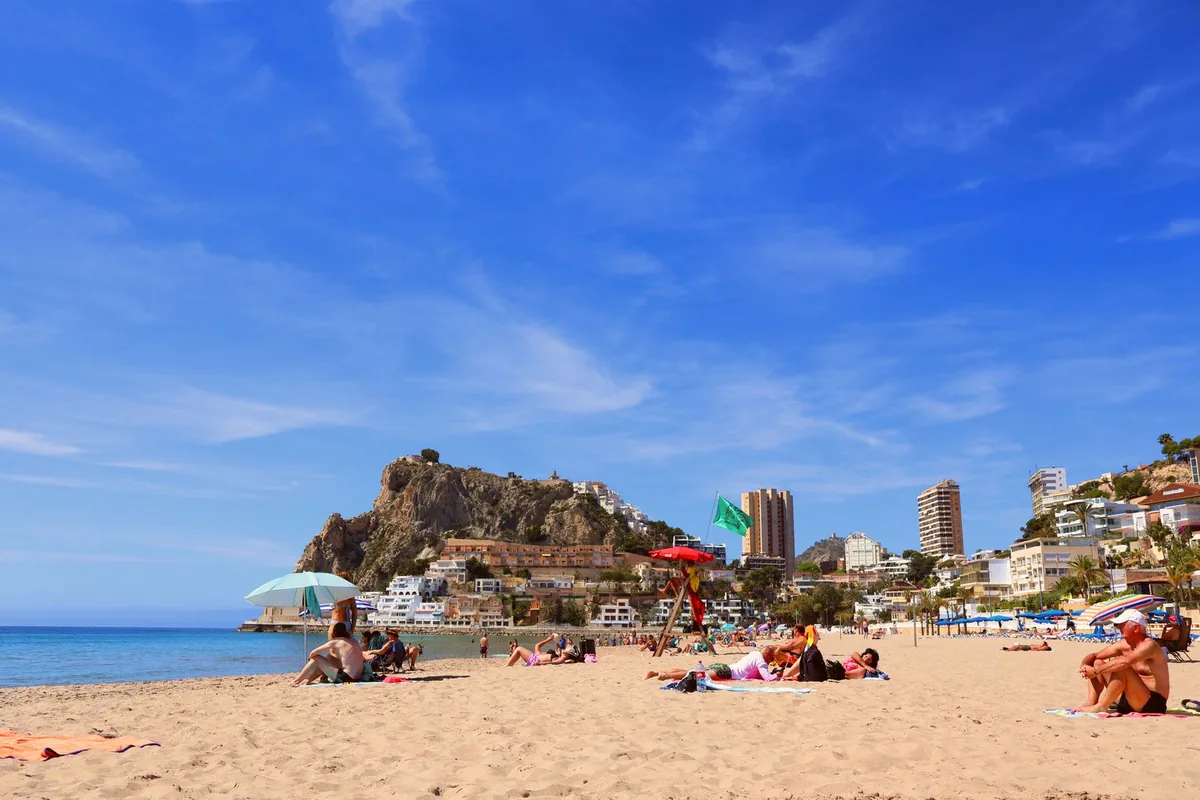
AQA's sample photo cards print the photos in black and white, so ours are too.
Preparation: 15 minutes for all three cards. Note what you can say about each photo: who, where, what they're doing, the weather, your opinion.
Press start. Talk about the photos, then answer the conversation questions.
- Photos
Teacher: Háblame de las fotos.
English
Tell me about the photos.
Model description (Foundation)
En la primera foto hay mucha gente en una plaza grande. Hay turistas y personas sentadas en el centro de la plaza. Detrás hay terrazas con sombrillas. Hace sol y opinion: creo que hace calor. En la segunda foto hay una playa con mucha arena. Algunas personas toman el sol y hay edificios altos al fondo. opinion: Me gusta mucho esta foto reason: porque me encanta la playa.
In the first photo there are lots of people in a big square. There are tourists and people sitting in the middle of the square. Behind them there are café terraces with umbrellas. It is sunny and I think it is hot. In the second photo there is a beach with lots of sand. Some people are sunbathing and there are tall buildings in the background. I really like this photo because I love the beach.
- Q1
Teacher: ¿Adónde vas de vacaciones normalmente?
English
Where do you usually go on holiday?
Model answer
Normalmente voy a la costa con mi familia. opinion: Me encanta la playa reason: porque puedo nadar en el mar.
I usually go to the coast with my family. I love the beach because I can swim in the sea.
- Q2
Teacher: ¿Qué hiciste el verano pasado?
English
What did you do last summer?
Model answer
El verano pasado past: fui a Escocia con mis padres. past: Visité muchos castillos y opinion: fue muy divertido.
Last summer I went to Scotland with my parents. I visited lots of castles and it was great fun.
- Q3
Teacher: Háblame de tu ciudad o tu pueblo.
English
Tell me about your town or village.
Model answer
Vivo en un pueblo pequeño. Hay un parque y una piscina, pero no hay cine. opinion: Me gusta mi pueblo reason: porque es tranquilo.
I live in a small town. There is a park and a swimming pool, but there is no cinema. I like my town because it is quiet.
- Q4
Teacher: ¿Cuáles son las ventajas de internet?
English
What are the advantages of the internet?
Model answer
Internet es muy útil para hacer los deberes y para hablar con mis amigos. También veo series en el móvil.
The internet is very useful for doing homework and for talking to my friends. I also watch series on my phone.
Timeframes in these models: present throughout, plus past. In the real conversation your teacher picks the questions and follows up on what you say.
End of the photo card. Play your recording and check: did you say something about both photos, and develop each answer with a reason or an example?
AQA Higher photo card 1: Communication and the world around us
- During your preparation time, look at the two photos. You may make as many notes as you wish and use them during the test.
- Your teacher will ask you to talk about the content of these photos. The recommended time is approximately one and a half minutes. You must say at least one thing about each photo.
- After you have spoken about the content of the photos, your teacher will ask you questions related to any of the topics within the theme of Communication and the world around us.
AQA's sample photo cards print the photos in black and white, so ours are too.
Preparation: 15 minutes for all three cards. Note what you can say about each photo: who, where, what they're doing, the weather, your opinion.
Press start. Talk about the photos, then answer the conversation questions.
- Photos
Teacher: Háblame de las fotos.
English
Tell me about the photos.
Model description (Higher)
En la primera foto se ve una plaza muy bonita, que parece la Plaza Mayor de Madrid. Muchas personas están sentadas alrededor de una farola y otras están paseando o tomando algo en las terrazas. complex structure: Me imagino que son turistas, reason: porque algunos llevan mochila. Hace sol, así que opinion: debe de ser verano. En la segunda foto hay una playa en la costa mediterránea, con edificios muy altos al fondo. La gente está tomando el sol bajo las sombrillas. opinion: Para mí, conditional: sería el lugar ideal para descansar, aunque opinion: prefiero las playas más tranquilas.
In the first photo you can see a very pretty square, which looks like the Plaza Mayor in Madrid. Lots of people are sitting round a lamp-post and others are walking or having a drink on the terraces. I imagine they are tourists, because some are carrying rucksacks. It is sunny, so it must be summer. In the second photo there is a beach on the Mediterranean coast, with very tall buildings in the background. People are sunbathing under the umbrellas. For me it would be the ideal place to relax, although I prefer quieter beaches.
- Q1
Teacher: ¿Adónde vas de vacaciones normalmente?
English
Where do you usually go on holiday?
Model answer
Normalmente vamos a la costa, a una casa que tienen mis abuelos en Cornualles. opinion: Lo que más me gusta es hacer surf, reason: porque es emocionante. Sin embargo, el año que viene future: vamos a ir a España por primera vez.
We usually go to the coast, to a house my grandparents have in Cornwall. What I like most is surfing, because it is exciting. However, next year we are going to go to Spain for the first time.
- Q2
Teacher: ¿Qué hiciste el verano pasado?
English
What did you do last summer?
Model answer
El verano pasado past: fui a Italia con mi familia. past: Visitamos Roma y Florencia, y past: comimos pizza casi todos los días. past: Hacía muchísimo calor, pero opinion: lo pasé genial.
Last summer I went to Italy with my family. We visited Rome and Florence, and we ate pizza almost every day. It was extremely hot, but I had a great time.
- Q3
Teacher: Háblame de tu ciudad o tu pueblo.
English
Tell me about your town or village.
Model answer
Vivo en una ciudad bastante grande en el sur de Inglaterra. Hay muchas tiendas y un estadio de fútbol, pero opinion: el problema es que hay demasiado tráfico. opinion: En mi opinión, el ayuntamiento conditional: debería construir más carriles bici.
I live in quite a big city in the south of England. There are lots of shops and a football stadium, but the problem is that there is too much traffic. In my opinion, the council should build more cycle lanes.
- Q4
Teacher: ¿Cuáles son las ventajas de internet?
English
What are the advantages of the internet?
Model answer
Internet tiene muchas ventajas: puedes buscar información para los deberes y hablar con gente de todo el mundo. Ayer, por ejemplo, past: hice una videollamada con mi prima, que vive en Australia. opinion: Sin internet, mi vida conditional: sería muy aburrida.
The internet has lots of advantages: you can look up information for homework and talk to people all over the world. Yesterday, for example, I made a video call to my cousin, who lives in Australia. Without the internet my life would be very boring.
- Q5
Teacher: ¿Dónde te gustaría vivir en el futuro?
English
Where would you like to live in the future?
Model answer
conditional: Me gustaría vivir en una ciudad cerca del mar, como Barcelona, reason: porque hay mucha cultura y hace buen tiempo. complex structure: Cuando sea mayor, future: trabajaré como arquitecta y future: viviré en un piso con vistas al mar.
I would like to live in a city by the sea, like Barcelona, because there is lots of culture and the weather is good. When I am older I will work as an architect and live in a flat with a sea view.
Timeframes in these models: present throughout, plus conditional, future, past. In the real conversation your teacher picks the questions and follows up on what you say.
End of the photo card. Play your recording and check: did you say something about both photos, and develop each answer with a reason or an example?
AQA Foundation photo card 2: People and lifestyle
- During your preparation time, look at the two photos. You may make as many notes as you wish and use them during the test.
- Your teacher will ask you to talk about the content of these photos. The recommended time is approximately one minute. You must say at least one thing about each photo.
- After you have spoken about the content of the photos, your teacher will ask you questions related to any of the topics within the theme of People and lifestyle.

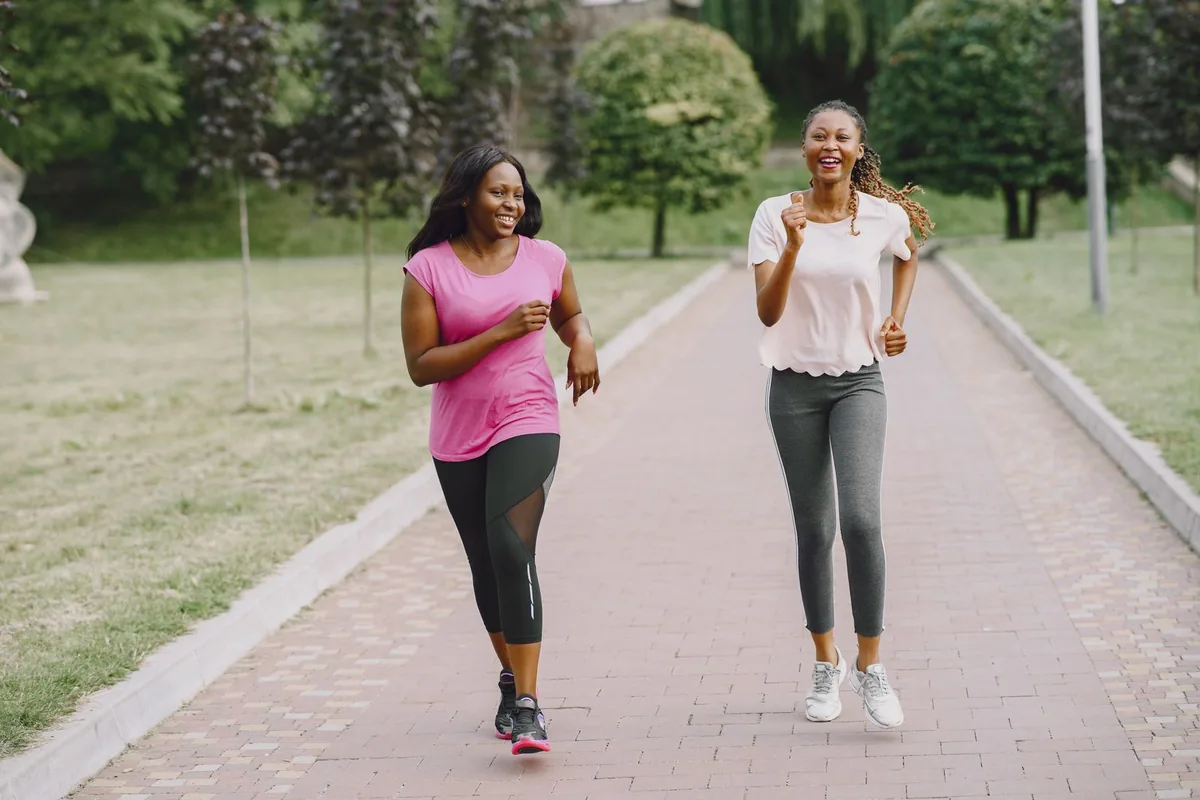
AQA's sample photo cards print the photos in black and white, so ours are too.
Preparation: 15 minutes for all three cards. Note what you can say about each photo: who, where, what they're doing, the weather, your opinion.
Press start. Talk about the photos, then answer the conversation questions.
- Photos
Teacher: Háblame de las fotos.
English
Tell me about the photos.
Model description (Foundation)
En la primera foto hay una familia en un jardín. Hay cuatro personas: dos chicos, una mujer y un hombre. Están comiendo en una mesa grande y hay fruta y ensalada. En la segunda foto hay dos chicas en un parque. Están corriendo y están muy contentas. opinion: Creo que es una foto muy positiva.
In the first photo there is a family in a garden. There are four people: two boys, a woman and a man. They are eating at a big table and there is fruit and salad. In the second photo there are two girls in a park. They are running and they are very happy. I think it is a very positive photo.
- Q1
Teacher: ¿Qué haces para estar en forma?
English
What do you do to keep fit?
Model answer
Juego al fútbol dos veces a la semana y voy al instituto en bicicleta. También bebo mucha agua.
I play football twice a week and I cycle to school. I also drink lots of water.
- Q2
Teacher: ¿Qué comiste ayer?
English
What did you eat yesterday?
Model answer
Ayer past: comí pollo con patatas y una ensalada. opinion: Me gustó mucho.
Yesterday I ate chicken with potatoes and a salad. I really liked it.
- Q3
Teacher: ¿Te llevas bien con tu familia?
English
Do you get on well with your family?
Model answer
Sí, me llevo bien con mis padres reason: porque son simpáticos, pero a veces discuto con mi hermano.
Yes, I get on well with my parents because they are nice, but sometimes I argue with my brother.
- Q4
Teacher: ¿Qué piensas de tu colegio?
English
What do you think of your school?
Model answer
opinion: Me gusta mi colegio reason: porque tengo muchos amigos. Mi asignatura favorita es el dibujo, pero no me gustan las matemáticas.
I like my school because I have lots of friends. My favourite subject is art, but I do not like maths.
Timeframes in these models: present throughout, plus past. In the real conversation your teacher picks the questions and follows up on what you say.
End of the photo card. Play your recording and check: did you say something about both photos, and develop each answer with a reason or an example?
AQA Higher photo card 2: People and lifestyle
- During your preparation time, look at the two photos. You may make as many notes as you wish and use them during the test.
- Your teacher will ask you to talk about the content of these photos. The recommended time is approximately one and a half minutes. You must say at least one thing about each photo.
- After you have spoken about the content of the photos, your teacher will ask you questions related to any of the topics within the theme of People and lifestyle.
AQA's sample photo cards print the photos in black and white, so ours are too.
Preparation: 15 minutes for all three cards. Note what you can say about each photo: who, where, what they're doing, the weather, your opinion.
Press start. Talk about the photos, then answer the conversation questions.
- Photos
Teacher: Háblame de las fotos.
English
Tell me about the photos.
Model description (Higher)
En la primera foto se ve a una familia que está comiendo al aire libre, en un jardín. opinion: Creo que son los padres y sus dos hijos, y todos parecen muy contentos. En la mesa hay ensalada, pasta, fruta y una jarra de limonada, así que opinion: la comida parece muy sana. En la segunda foto, dos chicas están haciendo footing en un parque. Llevan ropa de deporte y se están riendo. opinion: Pienso que hacer ejercicio con una amiga es más divertido, reason: porque te motiva.
In the first photo you can see a family eating outdoors, in a garden. I think it is the parents and their two sons, and they all look very happy. On the table there is salad, pasta, fruit and a jug of lemonade, so the food looks very healthy. In the second photo, two girls are jogging in a park. They are wearing sports clothes and laughing. I think exercising with a friend is more fun, because it motivates you.
- Q1
Teacher: ¿Qué haces para estar en forma?
English
What do you do to keep fit?
Model answer
Intento llevar una vida sana: juego al baloncesto en un equipo y voy al gimnasio los fines de semana. Además, como mucha fruta y verdura. El mes que viene future: voy a correr una carrera de cinco kilómetros con mi madre.
I try to lead a healthy life: I play basketball in a team and go to the gym at the weekend. Also, I eat lots of fruit and vegetables. Next month I am going to run a five-kilometre race with my mother.
- Q2
Teacher: ¿Qué comiste ayer?
English
What did you eat yesterday?
Model answer
Ayer past: desayuné cereales y para comer past: tomé un bocadillo en el instituto. Por la noche mi padre past: preparó una paella deliciosa. opinion: Fue la mejor comida del día.
Yesterday I had cereal for breakfast and for lunch I had a sandwich at school. In the evening my father made a delicious paella. It was the best meal of the day.
- Q3
Teacher: ¿Te llevas bien con tu familia?
English
Do you get on well with your family?
Model answer
Sí, me llevo muy bien con mi madre reason: porque es muy comprensiva y siempre me escucha. Con mi hermano mayor past: me llevaba mal cuando éramos pequeños, pero ahora somos buenos amigos.
Yes, I get on very well with my mother because she is very understanding and always listens to me. I used to get on badly with my older brother when we were small, but now we are good friends.
- Q4
Teacher: ¿Qué piensas de tu colegio?
English
What do you think of your school?
Model answer
opinion: En general, me gusta mi colegio reason: porque los profesores nos ayudan mucho. Sin embargo, opinion: creo que hay demasiados exámenes y el día es muy largo. El año que viene future: voy a estudiar biología, química y español.
On the whole I like my school because the teachers help us a lot. However, I think there are too many exams and the day is very long. Next year I am going to study biology, chemistry and Spanish.
- Q5
Teacher: ¿Qué trabajo te gustaría hacer en el futuro?
English
What job would you like to do in the future?
Model answer
conditional: Me gustaría ser médica reason: porque quiero ayudar a la gente. Primero future: tendré que estudiar mucho en la universidad. complex structure: Cuando sea mayor, conditional: me encantaría trabajar en otro país, por ejemplo en España.
I would like to be a doctor because I want to help people. First I will have to study hard at university. When I am older I would love to work in another country, for example in Spain.
Timeframes in these models: present throughout, plus future, past, conditional. In the real conversation your teacher picks the questions and follows up on what you say.
End of the photo card. Play your recording and check: did you say something about both photos, and develop each answer with a reason or an example?
Pearson Edexcel Foundation picture task 1: My neighbourhood
Thematic context: My neighbourhood
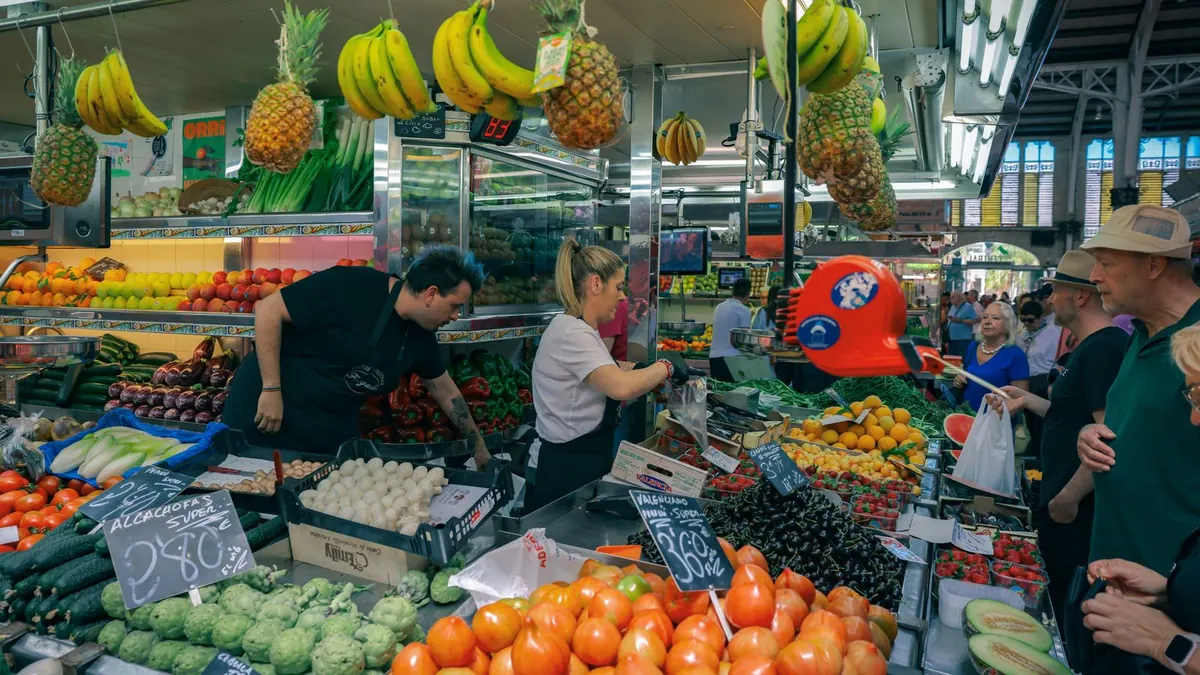
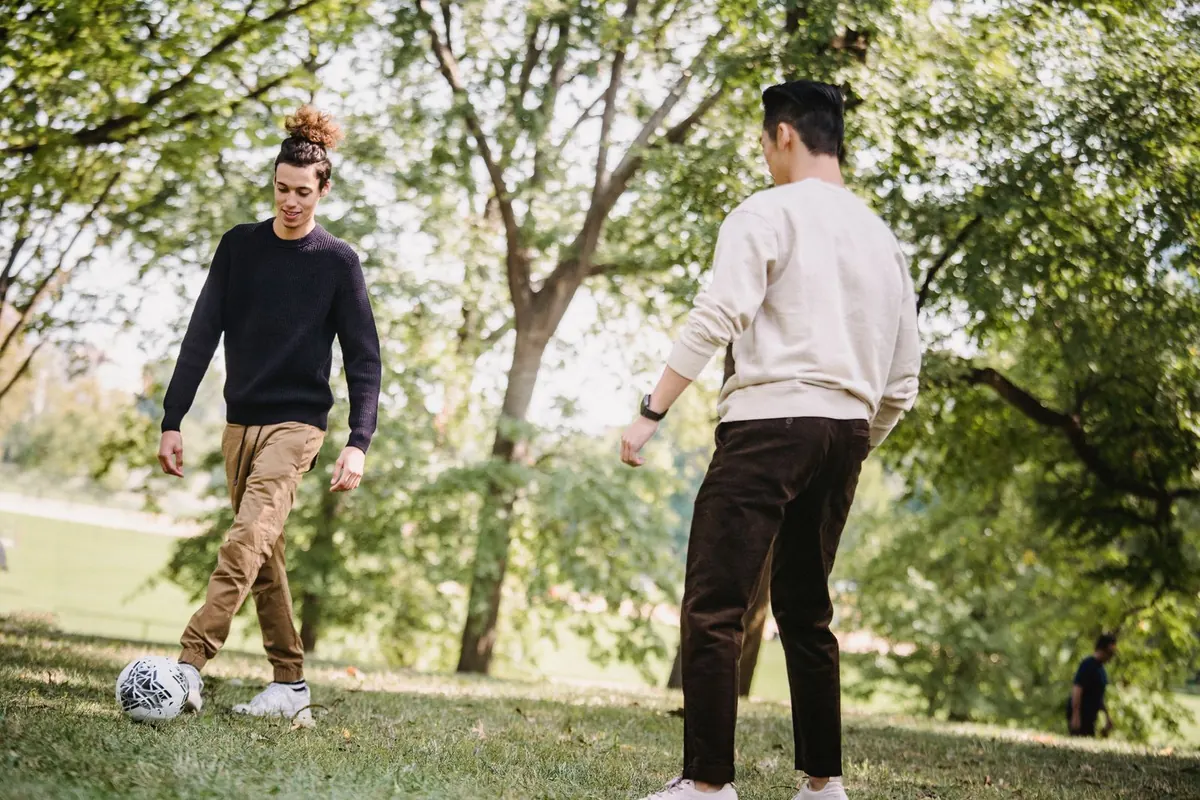
Describe ONE of these pictures. You will tell your teacher which one you have chosen to describe.
Your description must cover:
- people
- location
- activity.
When you have finished your description, your teacher will ask you two questions relating to your chosen picture. Say a few words or a short phrase or sentence in response to each question; one-word answers are not enough for full marks. You will then move on to a conversation on the broader thematic context of My neighbourhood.
Preparation: 15 minutes for all three cards. Choose your picture and note something about the people, the location and the activity.
Press start. Describe your picture, answer the two questions, then the conversation.
- Picture 1
Describe the picture: people, location, activity.
Model description (Foundation)
En la foto hay un mercado con mucha fruta y verdura. Hay dos personas que trabajan en el mercado y llevan delantales negros. Hay unos clientes que están comprando fruta. opinion: Creo que es un mercado en España, reason: porque los carteles están en español.
In the picture there is a market with lots of fruit and vegetables. There are two people who work at the market and they are wearing black aprons. Some customers are buying fruit. I think it is a market in Spain, because the signs are in Spanish.
- Q1
Teacher: ¿Dónde compras la comida normalmente?
English
Where do you usually buy food?
Model answer
Normalmente compro la comida en el supermercado con mi madre.
I usually buy food at the supermarket with my mother.
- Q2
Teacher: ¿Qué piensas de los mercados?
English
What do you think of markets?
Model answer
opinion: Me gustan los mercados reason: porque la fruta es muy fresca.
I like markets because the fruit is very fresh.
Conversation, starting with: where you live
- C1
Teacher: ¿Dónde vives?
English
Where do you live?
Model answer
Vivo en una casa en las afueras de Leeds. opinion: Me gusta mi casa reason: porque tengo un jardín grande.
I live in a house on the outskirts of Leeds. I like my house because I have a big garden.
- C2
Teacher: ¿Qué hiciste en tu barrio la semana pasada?
English
What did you do in your neighbourhood last week?
Model answer
La semana pasada past: fui al cine con mis amigos y después past: comimos una pizza.
Last week I went to the cinema with my friends and afterwards we ate a pizza.
- C3
Teacher: ¿Qué vas a hacer en tu barrio este fin de semana?
English
What are you going to do in your neighbourhood this weekend?
Model answer
Este fin de semana future: voy a jugar al fútbol en el parque con mi hermano.
This weekend I am going to play football in the park with my brother.
- C4
Teacher: ¿Qué te gustaría cambiar en tu barrio?
English
What would you like to change in your neighbourhood?
Model answer
conditional: Me gustaría tener más tiendas y un polideportivo nuevo, reason: porque no hay mucho para los jóvenes.
I would like more shops and a new sports centre, because there is not much for young people.
- Picture 2
Describe the picture: people, location, activity.
Model description (Foundation)
En la foto hay dos chicos en un parque. Están jugando al fútbol en la hierba. Hay muchos árboles y hace sol. Los chicos llevan ropa cómoda y opinion: parecen contentos.
In the picture there are two boys in a park. They are playing football on the grass. There are lots of trees and it is sunny. The boys are wearing comfortable clothes and they look happy.
- Q1
Teacher: ¿Qué haces en el parque?
English
What do you do in the park?
Model answer
En el parque juego al tenis con mi hermana o paseo con mi perro.
In the park I play tennis with my sister or walk my dog.
- Q2
Teacher: ¿Qué piensas de tu barrio?
English
What do you think of your neighbourhood?
Model answer
opinion: Me gusta mi barrio reason: porque es tranquilo y hay muchos espacios verdes.
I like my neighbourhood because it is quiet and there are lots of green spaces.
Conversation, starting with: where you live
- C1
Teacher: ¿Dónde vives?
English
Where do you live?
Model answer
Vivo en una casa en las afueras de Leeds. opinion: Me gusta mi casa reason: porque tengo un jardín grande.
I live in a house on the outskirts of Leeds. I like my house because I have a big garden.
- C2
Teacher: ¿Qué hiciste en tu barrio la semana pasada?
English
What did you do in your neighbourhood last week?
Model answer
La semana pasada past: fui al cine con mis amigos y después past: comimos una pizza.
Last week I went to the cinema with my friends and afterwards we ate a pizza.
- C3
Teacher: ¿Qué vas a hacer en tu barrio este fin de semana?
English
What are you going to do in your neighbourhood this weekend?
Model answer
Este fin de semana future: voy a jugar al fútbol en el parque con mi hermano.
This weekend I am going to play football in the park with my brother.
- C4
Teacher: ¿Qué te gustaría cambiar en tu barrio?
English
What would you like to change in your neighbourhood?
Model answer
conditional: Me gustaría tener más tiendas y un polideportivo nuevo, reason: porque no hay mucho para los jóvenes.
I would like more shops and a new sports centre, because there is not much for young people.
Timeframes in the conversation models: present, past, future, conditional. Pearson's top band for language asks for generally successful use of three timeframes.
End of the picture task. Did your description cover the people, the location and the activity? Did you use the past, present and future in the conversation?
Pearson Edexcel Higher picture task 1: My neighbourhood
Thematic context: My neighbourhood
Describe ONE of these pictures. You will tell your teacher which one you have chosen to describe.
Your description must cover:
- people
- location
- activity.
When you have finished your description, your teacher will ask you two questions relating to your chosen picture. Say a few words or a short phrase or sentence in response to each question; one-word answers are not enough for full marks. You will then move on to a conversation on the broader thematic context of My neighbourhood.
Preparation: 15 minutes for all three cards. Choose your picture and note something about the people, the location and the activity.
Press start. Describe your picture, answer the two questions, then the conversation.
- Picture 1
Describe the picture: people, location, activity.
Model description (Higher)
En esta foto se ve un puesto de frutas y verduras en un mercado cubierto, probablemente el Mercado Central de Valencia. Un chico y una chica, que llevan delantales negros, están atendiendo a los clientes: la chica está poniendo fruta en una bolsa. A la derecha hay dos señores mayores con sombrero que están esperando su turno. Hay tomates, alcachofas, cerezas y melones, y opinion: todo parece muy fresco.
In this picture you can see a fruit and vegetable stall in a covered market, probably the Mercado Central in Valencia. A young man and a young woman in black aprons are serving the customers: the woman is putting fruit into a bag. On the right there are two older men in hats waiting their turn. There are tomatoes, artichokes, cherries and melons, and everything looks very fresh.
- Q1
Teacher: ¿Qué tiendas hay en tu barrio?
English
What shops are there in your neighbourhood?
Model answer
En mi barrio hay un supermercado, una panadería y una farmacia, pero no hay ningún mercado. opinion: Es una pena, reason: porque me encantan los productos frescos.
In my neighbourhood there is a supermarket, a bakery and a chemist's, but there is no market. It is a shame, because I love fresh produce.
- Q2
Teacher: ¿Qué compraste la última vez que fuiste de compras?
English
What did you buy the last time you went shopping?
Model answer
La última vez que past: fui de compras past: compré unas zapatillas y una camiseta para el verano. past: Me costaron bastante, pero opinion: valieron la pena.
The last time I went shopping I bought some trainers and a T-shirt for the summer. They cost quite a lot, but they were worth it.
Conversation, starting with: where you live
- C1
Teacher: ¿Cómo es tu barrio?
English
What is your neighbourhood like?
Model answer
Mi barrio está cerca del centro y tiene de todo: tiendas, restaurantes y un parque enorme. Lo malo es que hay mucho tráfico por la mañana. opinion: Aun así, me encanta vivir aquí, reason: porque mis amigos viven cerca.
My neighbourhood is near the centre and has everything: shops, restaurants and a huge park. The bad thing is that there is a lot of traffic in the morning. Even so, I love living here, because my friends live nearby.
- C2
Teacher: ¿Cómo ha cambiado tu barrio en los últimos años?
English
How has your neighbourhood changed in recent years?
Model answer
past: Ha cambiado bastante. Hace cinco años past: había una fábrica abandonada, pero la past: convirtieron en un centro juvenil. Ahora hay más actividades para los jóvenes.
It has changed quite a lot. Five years ago there was an abandoned factory, but they turned it into a youth centre. Now there are more activities for young people.
- C3
Teacher: ¿Dónde te gustaría vivir en el futuro?
English
Where would you like to live in the future?
Model answer
conditional: Me gustaría vivir en el campo, reason: porque es más tranquilo y hay menos contaminación. Sin embargo, complex structure: cuando termine mis estudios, future: buscaré trabajo en una ciudad grande.
I would like to live in the countryside, because it is quieter and there is less pollution. However, when I finish my studies I will look for work in a big city.
- C4
Teacher: ¿Qué harás en tu barrio este fin de semana?
English
What will you do in your neighbourhood this weekend?
Model answer
El sábado future: iré al mercado con mi padre y por la tarde future: veré un partido en casa de una amiga. future: Será divertido.
On Saturday I will go to the market with my father and in the afternoon I will watch a match at a friend's house. It will be fun.
- Picture 2
Describe the picture: people, location, activity.
Model description (Higher)
En esta foto hay dos jóvenes que están jugando al fútbol en un parque. Uno tiene el pelo rizado y lleva un jersey oscuro; el otro está de espaldas y lleva una sudadera clara. Están debajo de unos árboles muy grandes y hace sol, así que opinion: debe de ser primavera o principios de otoño. opinion: Me parece una buena manera de pasar la tarde, reason: porque es gratis y sano.
In this picture there are two young men playing football in a park. One has curly hair and is wearing a dark jumper; the other has his back to us and is wearing a light sweatshirt. They are under some very big trees and it is sunny, so it must be spring or early autumn. It seems a good way to spend the afternoon to me, because it is free and healthy.
- Q1
Teacher: ¿Qué te gusta hacer al aire libre?
English
What do you like doing outdoors?
Model answer
opinion: Me encanta montar en bici por el campo y, cuando hace buen tiempo, juego al voleibol con mis amigas en el parque.
I love cycling in the countryside and, when the weather is good, I play volleyball with my friends in the park.
- Q2
Teacher: ¿Qué hiciste el fin de semana pasado en tu barrio?
English
What did you do in your neighbourhood last weekend?
Model answer
El sábado pasado past: fui al mercado con mi abuela y por la tarde past: jugué al baloncesto en el polideportivo. opinion: Fue un fin de semana muy tranquilo.
Last Saturday I went to the market with my grandmother and in the afternoon I played basketball at the sports centre. It was a very quiet weekend.
Conversation, starting with: where you live
- C1
Teacher: ¿Cómo es tu barrio?
English
What is your neighbourhood like?
Model answer
Mi barrio está cerca del centro y tiene de todo: tiendas, restaurantes y un parque enorme. Lo malo es que hay mucho tráfico por la mañana. opinion: Aun así, me encanta vivir aquí, reason: porque mis amigos viven cerca.
My neighbourhood is near the centre and has everything: shops, restaurants and a huge park. The bad thing is that there is a lot of traffic in the morning. Even so, I love living here, because my friends live nearby.
- C2
Teacher: ¿Cómo ha cambiado tu barrio en los últimos años?
English
How has your neighbourhood changed in recent years?
Model answer
past: Ha cambiado bastante. Hace cinco años past: había una fábrica abandonada, pero la past: convirtieron en un centro juvenil. Ahora hay más actividades para los jóvenes.
It has changed quite a lot. Five years ago there was an abandoned factory, but they turned it into a youth centre. Now there are more activities for young people.
- C3
Teacher: ¿Dónde te gustaría vivir en el futuro?
English
Where would you like to live in the future?
Model answer
conditional: Me gustaría vivir en el campo, reason: porque es más tranquilo y hay menos contaminación. Sin embargo, complex structure: cuando termine mis estudios, future: buscaré trabajo en una ciudad grande.
I would like to live in the countryside, because it is quieter and there is less pollution. However, when I finish my studies I will look for work in a big city.
- C4
Teacher: ¿Qué harás en tu barrio este fin de semana?
English
What will you do in your neighbourhood this weekend?
Model answer
El sábado future: iré al mercado con mi padre y por la tarde future: veré un partido en casa de una amiga. future: Será divertido.
On Saturday I will go to the market with my father and in the afternoon I will watch a match at a friend's house. It will be fun.
Timeframes in the conversation models: present, past, conditional, future. Pearson's top band for language asks for consistently successful use of three timeframes.
End of the picture task. Did your description cover the people, the location and the activity? Did you use the past, present and future in the conversation?
Pearson Edexcel Foundation picture task 2: Media and technology
Thematic context: Media and technology


Describe ONE of these pictures. You will tell your teacher which one you have chosen to describe.
Your description must cover:
- people
- location
- activity.
When you have finished your description, your teacher will ask you two questions relating to your chosen picture. Say a few words or a short phrase or sentence in response to each question; one-word answers are not enough for full marks. You will then move on to a conversation on the broader thematic context of Media and technology.
Preparation: 15 minutes for all three cards. Choose your picture and note something about the people, the location and the activity.
Press start. Describe your picture, answer the two questions, then the conversation.
- Picture 1
Describe the picture: people, location, activity.
Model description (Foundation)
En la foto hay unas chicas jóvenes. Están sentadas en unas escaleras de piedra, al aire libre. Tres chicas miran los móviles. Hace sol y opinion: creo que es verano, reason: porque llevan ropa de verano.
In the picture there are some girls. They are sitting on some stone steps outdoors. Three girls are looking at the mobile phones. It is sunny and I think it is summer, because they are wearing summer clothes.
- Q1
Teacher: ¿Cuántas horas al día usas el móvil?
English
How many hours a day do you use your mobile?
Model answer
Uso el móvil unas tres horas al día, sobre todo por la tarde.
I use my mobile for about three hours a day, especially in the afternoon.
- Q2
Teacher: ¿Qué piensas de los móviles?
English
What do you think of mobile phones?
Model answer
opinion: Me parecen muy útiles reason: porque puedo hablar con mis amigos en cualquier momento.
I think they are very useful because I can talk to my friends at any time.
Conversation, starting with: social media
- C1
Teacher: ¿Qué redes sociales usas?
English
Which social media do you use?
Model answer
Uso las redes sociales para ver vídeos y hablar con mis amigos. opinion: Me gustan reason: porque son divertidas.
I use social media to watch videos and talk to my friends. I like them because they are fun.
- C2
Teacher: ¿Qué hiciste en internet el fin de semana pasado?
English
What did you do online last weekend?
Model answer
El fin de semana pasado past: vi una película y past: jugué a los videojuegos con mi hermano.
Last weekend I watched a film and played video games with my brother.
- C3
Teacher: ¿Cómo vas a usar la tecnología en el futuro?
English
How are you going to use technology in the future?
Model answer
En el futuro future: voy a usar el ordenador para trabajar y para aprender idiomas.
In the future I am going to use the computer for work and to learn languages.
- C4
Teacher: ¿Cuáles son los peligros de internet?
English
What are the dangers of the internet?
Model answer
Hay gente peligrosa en internet y opinion: creo que no es bueno hablar con desconocidos.
There are dangerous people on the internet and I think it is not good to talk to strangers.
- Picture 2
Describe the picture: people, location, activity.
Model description (Foundation)
En la foto hay tres amigos en una plaza. Están haciendo una foto con el móvil. Detrás hay una fuente grande y unos árboles. opinion: Los tres parecen muy contentos.
In the picture there are three friends in a square. They are taking a photo with a mobile phone. Behind them there is a big fountain and some trees. All three look very happy.
- Q1
Teacher: ¿Te gusta hacer fotos?
English
Do you like taking photos?
Model answer
Sí, opinion: me encanta hacer fotos cuando salgo con mis amigos.
Yes, I love taking photos when I go out with my friends.
- Q2
Teacher: ¿Qué haces con tu móvil?
English
What do you do with your mobile?
Model answer
Con mi móvil escucho música y hablo con mi familia.
On my mobile I listen to music and talk to my family.
Conversation, starting with: social media
- C1
Teacher: ¿Qué redes sociales usas?
English
Which social media do you use?
Model answer
Uso las redes sociales para ver vídeos y hablar con mis amigos. opinion: Me gustan reason: porque son divertidas.
I use social media to watch videos and talk to my friends. I like them because they are fun.
- C2
Teacher: ¿Qué hiciste en internet el fin de semana pasado?
English
What did you do online last weekend?
Model answer
El fin de semana pasado past: vi una película y past: jugué a los videojuegos con mi hermano.
Last weekend I watched a film and played video games with my brother.
- C3
Teacher: ¿Cómo vas a usar la tecnología en el futuro?
English
How are you going to use technology in the future?
Model answer
En el futuro future: voy a usar el ordenador para trabajar y para aprender idiomas.
In the future I am going to use the computer for work and to learn languages.
- C4
Teacher: ¿Cuáles son los peligros de internet?
English
What are the dangers of the internet?
Model answer
Hay gente peligrosa en internet y opinion: creo que no es bueno hablar con desconocidos.
There are dangerous people on the internet and I think it is not good to talk to strangers.
Timeframes in the conversation models: present, past, future. Pearson's top band for language asks for generally successful use of three timeframes.
End of the picture task. Did your description cover the people, the location and the activity? Did you use the past, present and future in the conversation?
Pearson Edexcel Higher picture task 2: Media and technology
Thematic context: Media and technology
Describe ONE of these pictures. You will tell your teacher which one you have chosen to describe.
Your description must cover:
- people
- location
- activity.
When you have finished your description, your teacher will ask you two questions relating to your chosen picture. Say a few words or a short phrase or sentence in response to each question; one-word answers are not enough for full marks. You will then move on to a conversation on the broader thematic context of Media and technology.
Preparation: 15 minutes for all three cards. Choose your picture and note something about the people, the location and the activity.
Press start. Describe your picture, answer the two questions, then the conversation.
- Picture 1
Describe the picture: people, location, activity.
Model description (Higher)
En esta foto se ve a un grupo de chicas jóvenes al aire libre. Delante, sentadas en unos escalones de piedra, hay tres chicas que miran los móviles. La chica del medio, que lleva una camiseta amarilla, tiene un móvil blanco en la mano, y la chica de la derecha, que lleva un top blanco, mira la pantalla con atención. Arriba, en el muro, hay dos chicas más; una de ellas, que lleva una chaqueta negra, parece que está comiendo un helado. Hace mucho sol y casi todas llevan ropa de verano, así que complex structure: debe de ser verano. complex structure: Me imagino que se están enseñando fotos o mensajes.
In this picture you can see a group of girls outdoors. At the front, sitting on some stone steps, there are three girls looking at the mobile phones. The girl in the middle, who is wearing a yellow T-shirt, has a white mobile in her hand, and the girl on the right, who is wearing a white top, is looking closely at the screen. Up on the wall there are two more girls; one of them, who is wearing a black jacket, seems to be eating an ice cream. It is very sunny and almost all of them are wearing summer clothes, so it must be summer. I imagine they are showing each other photos or messages.
- Q1
Teacher: ¿Crees que los jóvenes usan demasiado el móvil?
English
Do you think young people use their mobiles too much?
Model answer
opinion: Sí, creo que lo usamos demasiado, reason: porque miramos el móvil incluso cuando estamos con nuestros amigos. conditional: Sería mejor dejarlo en la mochila de vez en cuando.
Yes, I think we use it too much, because we look at our mobiles even when we are with our friends. It would be better to leave it in our rucksacks from time to time.
- Q2
Teacher: ¿Para qué usaste el móvil ayer?
English
What did you use your mobile for yesterday?
Model answer
Ayer past: usé el móvil para buscar información sobre un trabajo de historia y luego past: hice una videollamada con mi tía, que vive en Francia. opinion: Fue muy práctico.
Yesterday I used my mobile to look up information for a history project and then I made a video call to my aunt, who lives in France. It was really handy.
Conversation, starting with: social media
- C1
Teacher: ¿Cuánto tiempo pasas en las redes sociales?
English
How much time do you spend on social media?
Model answer
Paso unas dos horas al día en las redes sociales, sobre todo por la noche. opinion: Sé que es demasiado, así que future: voy a intentar usarlas menos.
I spend about two hours a day on social media, especially in the evening. I know it is too much, so I am going to try to use them less.
- C2
Teacher: ¿Cómo usabas la tecnología hace cinco años?
English
How did you use technology five years ago?
Model answer
Hace cinco años no past: tenía móvil, así que past: usaba la tableta de mi madre para jugar. Ahora el móvil es imprescindible para mí.
Five years ago I did not have a mobile, so I used my mother's tablet to play games. Now my mobile is essential to me.
- C3
Teacher: ¿Cómo será la tecnología en el futuro?
English
What will technology be like in the future?
Model answer
opinion: Creo que en el futuro los coches future: serán eléctricos y autónomos, y future: usaremos la inteligencia artificial para todo. opinion: Me preocupa un poco, reason: porque podríamos perder muchos trabajos.
I think that in the future cars will be electric and driverless, and we will use artificial intelligence for everything. It worries me a bit, because we could lose lots of jobs.
- C4
Teacher: ¿Cuáles son los peligros de internet?
English
What are the dangers of the internet?
Model answer
El mayor peligro es el ciberacoso. Además, hay mucha información falsa y opinion: creo que es importante comprobar las noticias. El año pasado past: tuvimos una charla sobre la seguridad en internet en mi instituto y past: aprendí mucho.
The biggest danger is cyberbullying. Also, there is a lot of false information and I think it is important to check the news. Last year we had a talk about internet safety at my school and I learnt a lot.
- Picture 2
Describe the picture: people, location, activity.
Model description (Higher)
En esta foto hay tres amigos que se están haciendo un selfi en una plaza. El chico, que lleva una chaqueta vaquera, sostiene el móvil y hace el signo de la victoria. Las dos chicas, que llevan mochila, están sonriendo. Al fondo se ve una fuente con estatuas y un banco con la estatua de un hombre con sombrero, así que complex structure: me imagino que están de viaje en una ciudad europea. opinion: Parecen muy felices.
In this picture there are three friends taking a selfie in a square. The young man, who is wearing a denim jacket, is holding the phone and making a V sign. The two girls, who are carrying rucksacks, are smiling. In the background you can see a fountain with statues and a bench with a statue of a man in a hat, so I imagine they are travelling in a European city. They look very happy.
- Q1
Teacher: ¿Qué piensas de hacer selfis?
English
What do you think of taking selfies?
Model answer
opinion: Creo que los selfis son divertidos, pero no me gusta compartirlos en las redes sociales, reason: porque prefiero proteger mi privacidad.
I think selfies are fun, but I do not like sharing them on social media, because I prefer to protect my privacy.
- Q2
Teacher: ¿Cuándo hiciste tu última foto con amigos?
English
When did you last take a photo with friends?
Model answer
La past: hice el sábado pasado en el cumpleaños de mi mejor amiga. past: Fuimos a una bolera y luego past: cenamos en un restaurante italiano.
I took it last Saturday at my best friend's birthday. We went bowling and then had dinner at an Italian restaurant.
Conversation, starting with: social media
- C1
Teacher: ¿Cuánto tiempo pasas en las redes sociales?
English
How much time do you spend on social media?
Model answer
Paso unas dos horas al día en las redes sociales, sobre todo por la noche. opinion: Sé que es demasiado, así que future: voy a intentar usarlas menos.
I spend about two hours a day on social media, especially in the evening. I know it is too much, so I am going to try to use them less.
- C2
Teacher: ¿Cómo usabas la tecnología hace cinco años?
English
How did you use technology five years ago?
Model answer
Hace cinco años no past: tenía móvil, así que past: usaba la tableta de mi madre para jugar. Ahora el móvil es imprescindible para mí.
Five years ago I did not have a mobile, so I used my mother's tablet to play games. Now my mobile is essential to me.
- C3
Teacher: ¿Cómo será la tecnología en el futuro?
English
What will technology be like in the future?
Model answer
opinion: Creo que en el futuro los coches future: serán eléctricos y autónomos, y future: usaremos la inteligencia artificial para todo. opinion: Me preocupa un poco, reason: porque podríamos perder muchos trabajos.
I think that in the future cars will be electric and driverless, and we will use artificial intelligence for everything. It worries me a bit, because we could lose lots of jobs.
- C4
Teacher: ¿Cuáles son los peligros de internet?
English
What are the dangers of the internet?
Model answer
El mayor peligro es el ciberacoso. Además, hay mucha información falsa y opinion: creo que es importante comprobar las noticias. El año pasado past: tuvimos una charla sobre la seguridad en internet en mi instituto y past: aprendí mucho.
The biggest danger is cyberbullying. Also, there is a lot of false information and I think it is important to check the news. Last year we had a talk about internet safety at my school and I learnt a lot.
Timeframes in the conversation models: present, future, past. Pearson's top band for language asks for consistently successful use of three timeframes.
End of the picture task. Did your description cover the people, the location and the activity? Did you use the past, present and future in the conversation?
Photos from Unsplash and Pexels, used under their free licences; credits on file. The tasks are written for this site in each board's format.
Getting the marks
No single phrase or tense guarantees a grade. What the mark schemes reward is clear communication, developed answers and, for language, range and accuracy.
AQA: what the top bands ask for
- Role-play: each message conveyed without ambiguity; perfect Spanish isn't required
- Conversation (communication): quite a lot of information, with regular good development of answers
- Conversation (language): a good variety of vocabulary and structures at Foundation; at Higher, a wide variety, with few or no major errors when you attempt more complex language
Pearson Edexcel: what the top bands ask for
- Read aloud: pronunciation consistently clear and comprehensible; slips in the sound-symbol correspondences don't affect the message
- Conversation (language), top band: "generally successful use of three timeframes" at Foundation and "consistently successful use of three timeframes" at Higher (past, present and future)
- Conversation (communication): relevant answers, ideas developed with extended sequences of speech
On both boards
- Role-play: answer exactly what the prompt asks, with a verb, and check which prompt is your question
- Develop answers: say what, then why (porque, ya que), then an example or a time (el año pasado, el verano que viene)
- Describing a photo: En la foto hay..., Veo..., Están... + -ando / -iendo
- Read aloud: every vowel is clear, h is silent, ll and y sound alike, j and ge/gi are breathy, and r between vowels is a tap
Sources
Exam details checked 18 October 2026 against the official documents. Boards can change the format, so check your teacher's information for your exam year.
- AQA GCSE Spanish (8692) specificationVersion 1.3, September 2025
- AQA GCSE Spanish support and resources (specimen papers, vocabulary)
- Pearson Edexcel GCSE Spanish (1SP1) qualification page
- Pearson Edexcel specification (PDF)Issue 2, May 2025
- Pearson Edexcel sample assessment materials (PDF)Issue 3, August 2025
Speaking facts: AQA 8692 specification v1.3 (September 2025), sections 4.5 and 4.8.2; AQA 8692/SF+SH Paper 2 Speaking sample assessment materials: Teacher's Booklet, item commentary booklet and mark scheme; Pearson Edexcel 1SP1 specification Issue 2 (May 2025), Paper 1: Speaking in Spanish; Pearson Edexcel sample assessment materials Issue 3 (August 2025), Paper 1 candidate and teacher cards and assessment criteria (Foundation and Higher).
On this page: 8 role-plays, 8 read-aloud texts and 8 photo cards and picture tasks, two per board and tier for each task.
More GCSE practice: sounds and dictation. Back to the GCSE speaking exam overview.